
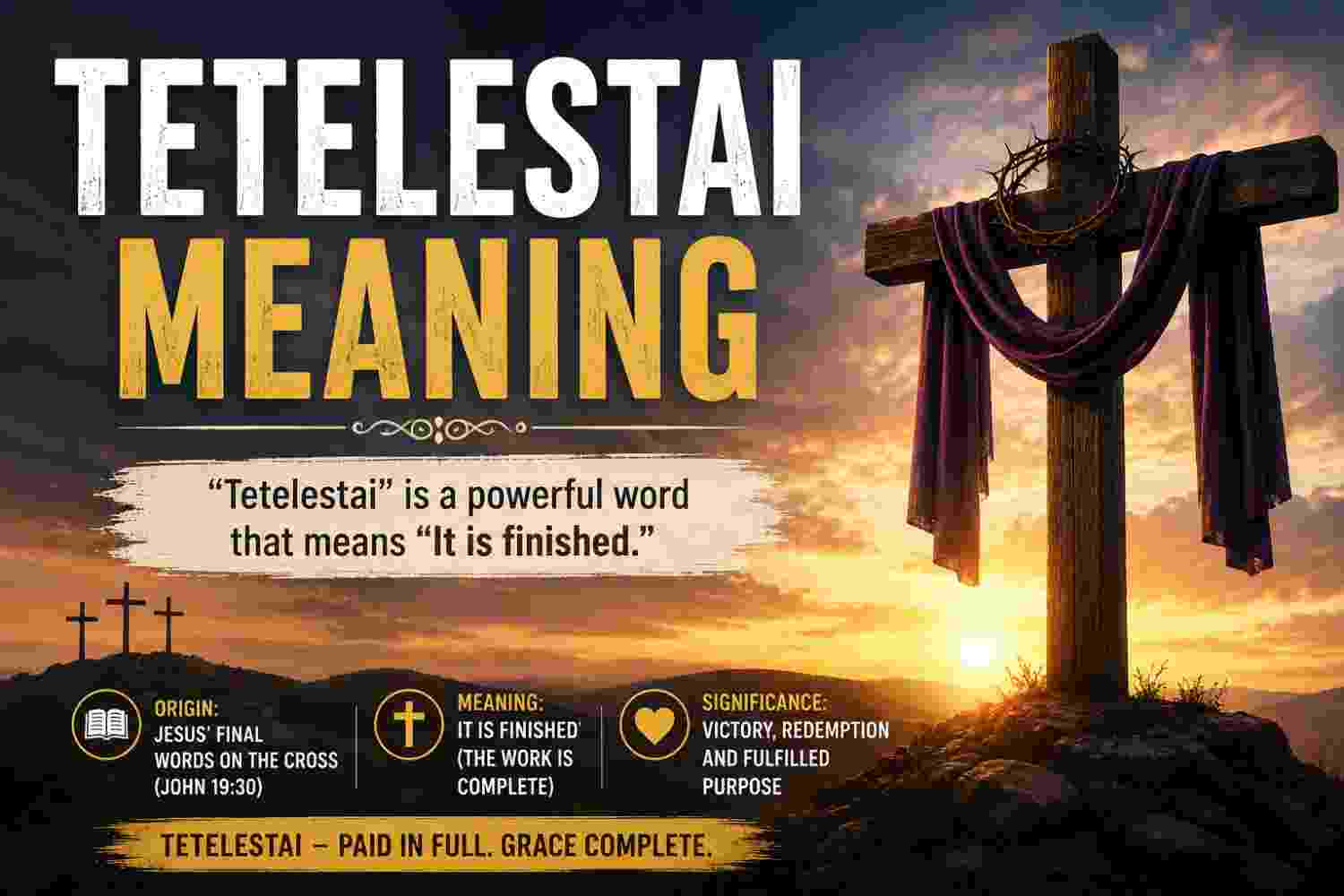
Picture a Roman jailer stamping a debt certificate with a single word, and that word wipes the account clean forever. That’s the world behind tetelestai, and once you see it, you can’t unsee it.
Most readers gloss over Jesus’s final words on the cross without realizing they’re standing on top of a legal, financial, and spiritual explosion. This article unpacks the tetelestai meaning layer by layer, using the original Greek, the historical record, and the biblical context most sermons skip.
What Does Tetelestai Actually Mean?
Tetelestai comes from the Greek verb teleo, which carries the idea of bringing something to its intended goal. It’s not a shrug of exhaustion. It’s a declaration of victory over a task that has now reached full completion.
The word shows up once, in John 19:30, as Jesus’s last recorded statement before his death. Most English Bibles translate it simply as “It is finished,” but that three-word phrase barely scratches the surface of what the original audience heard.
The Original Greek Breakdown
In Koine Greek, tetelestai is written in the perfect tense, and that grammatical detail matters more than people realize. The perfect tense describes an action completed in the past that carries ongoing results into the present.
That means the closest English equivalent isn’t “it is finished” but something closer to “it has been finished, and it remains finished.” The completion isn’t temporary or partial. It’s permanent, sealed, and unrepeatable.
Here’s a quick breakdown of the word’s grammatical DNA:
| Element | Detail |
|---|---|
| Root verb | teleo (to complete, to accomplish) |
| Tense used | Perfect indicative passive |
| Literal sense | “It has been brought to its goal” |
| Common translation | “It is finished” |
| Single biblical use | John 19:30 |
The passive voice also matters. Jesus wasn’t just stating a fact about himself; he was declaring that something had been done to the situation, a task fully executed with no loose ends left hanging.
Where Tetelestai Appears in the Bible
Scholars often point out that tetelestai appears only once in the New Testament, spoken directly by Jesus. That rarity gives the word extra weight, since it wasn’t a common phrase repeated throughout scripture.
The Context of John 19:30
The verse reads that after receiving the sour wine, Jesus said, “It is finished,” and bowed his head and gave up his spirit. The sequence isn’t random. He speaks the word, then chooses to release his life.
That order flips the usual assumption that death simply happened to him. In the Greek narrative structure, the completion comes first, and the surrender of life follows as a deliberate act, not a passive collapse.
A Related Word Earlier in John’s Gospel
Just a few verses earlier, John notes that Jesus knew all things had already been accomplished, using a related form of the same root word. That repetition signals the author wanted readers to catch the theme of completion building toward the final cry.
Why This One Word Carries So Much Weight
Understanding tetelestai meaning requires stepping outside the church building and into the everyday marketplace of the first century. This word wasn’t invented for religious use. People used it constantly in ordinary life.
Financial and Legal Uses in Ancient Greece
Archaeologists have found ancient receipts and tax documents stamped with the word tetelestai, meaning “paid in full.” A merchant collecting a debt would write this exact term across the ledger once the balance hit zero.
That single detail changes how you read the crucifixion scene. Jesus wasn’t only speaking about his physical suffering ending. He was borrowing courtroom and marketplace language to declare a debt fully settled.
A Word Used in Craftsmanship Too
Greek artisans used forms of teleo when a masterpiece met every requirement of the design. A sculptor or builder would use it once the work matched the original blueprint exactly, with nothing missing and nothing extra.
That craftsmanship angle adds another layer. The word suggests precision, not just an ending. It implies the finished product matches a plan drawn up long before the final brushstroke.
Tetelestai vs Other Biblical Words of Completion
Scripture uses several Greek words that touch on the idea of ending, and confusing them muddies the real meaning. A brief side-by-side clarifies the situation.
| Greek Word | Core Meaning | Typical Usage |
|---|---|---|
| Tetelestai | Fully accomplished, debt paid | Jesus’s final statement, John 19:30 |
| Ginomai | To become, to happen | General events occurring |
| Pauo | To stop, to cease | Simple cessation of activity |
| Katargeo | To render powerless | Nullifying a force or law |
Notice that tetelestai stands apart from words like pauo, which just means something stopped happening. Tetelestai carries success baked into it, not just termination.
How to Apply the Meaning of Tetelestai Today
People bring up this word most often around Easter, but its practical weight stretches far beyond one holiday. Here’s how readers commonly apply it in daily life:
- Releasing guilt: Many describe using the word as a mental anchor when old regrets resurface, treating the matter as legally closed.
- Facing unfinished projects: Writers and creatives sometimes borrow the concept to push through to a true finish line rather than stopping halfway.
- Grief processing: Some find comfort framing loss through a lens of completion rather than sudden, meaningless interruption.
- Financial mindset: A few teachers use the ancient “paid in full” stamp imagery to talk about debt freedom, both literal and symbolic.
None of these applications require a theology degree. The word simply gives people a concrete image, a stamped receipt, that’s easier to hold onto than an abstract idea.
Frequently Asked Questions
What does tetelestai literally translate to in English?
It translates most literally to “it has been finished” or “it stands accomplished,” reflecting the Greek perfect tense rather than a simple past-tense ending.
Is tetelestai the same as saying “I’m done”?
Not quite. “I’m done” can describe quitting or stopping midway. Tetelestai specifically implies a goal was reached in full, matching an original plan or requirement.
Why was tetelestai written on ancient receipts?
Merchants and tax collectors stamped this word on documents once a debt reached zero balance, functioning much like “paid in full” does on a modern invoice.
Did Jesus speak this word in Greek or Aramaic?
John’s gospel records the statement in Greek, though Jesus likely spoke Aramaic in daily life. Scholars generally agree John chose the Greek term deliberately for its legal and financial resonance.
How many times does tetelestai appear in the New Testament?
The exact word appears once, in John 19:30, though closely related forms of the same root verb, teleo, show up earlier in the same chapter and elsewhere in scripture.
Does tetelestai mean the same thing as “the end”?
No. “The end” simply marks a stopping point in time. Tetelestai marks successful completion of a specific task or obligation, closer to victory than to a mere conclusion.
Can tetelestai apply outside a religious context?
Yes. Its original use in commerce and craftsmanship means writers, coaches, and everyday people still borrow the word today to describe any goal brought fully to completion.
Final Thoughts
The tetelestai meaning isn’t a footnote for language nerds. It’s a courtroom stamp, a craftsman’s nod of approval, and a final declaration all rolled into one four-syllable word.
Next time you read “It is finished,” picture that ancient ledger with the balance struck to zero. That image sticks far longer than any textbook definition ever could.