
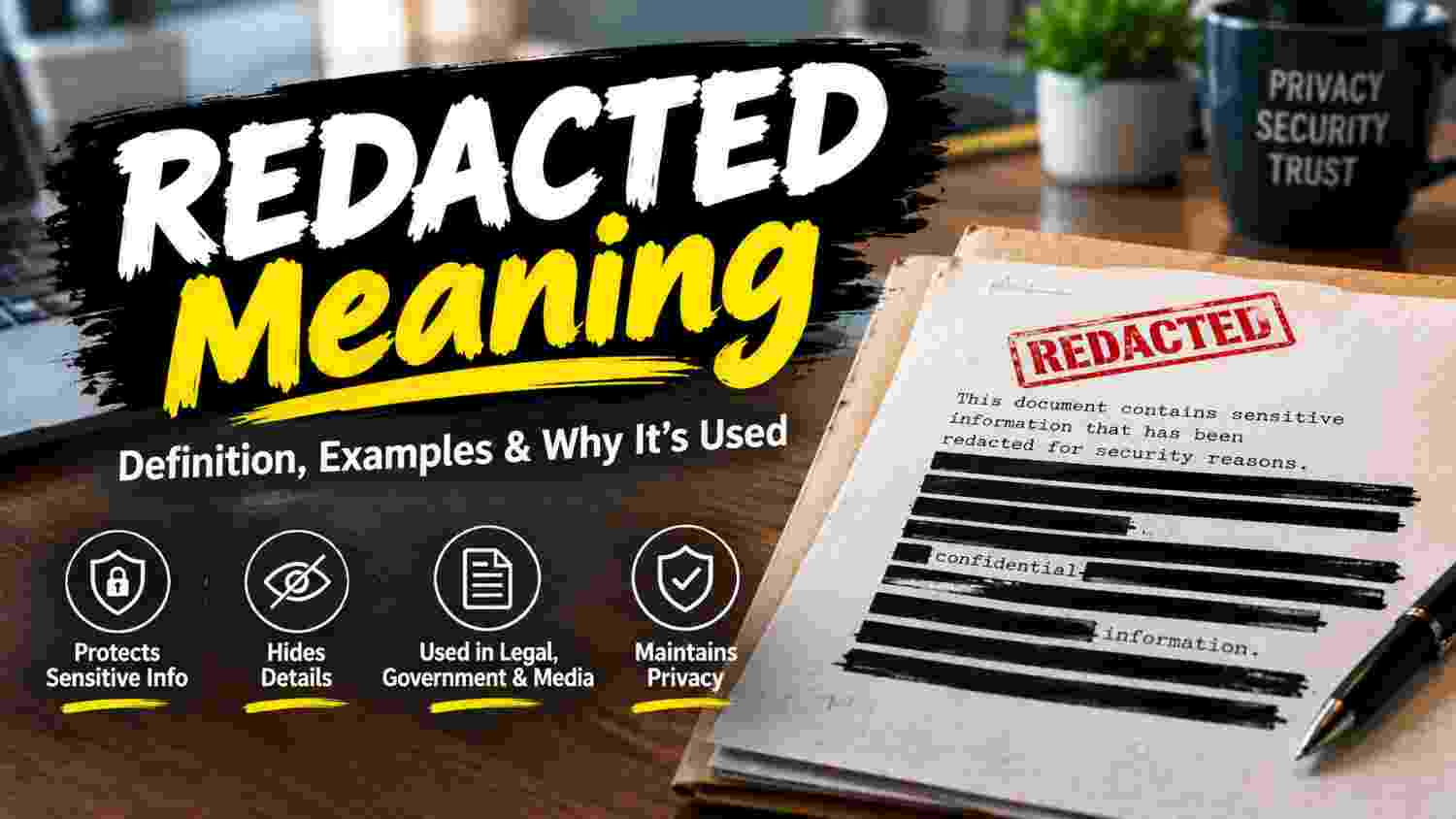
Seeing words hidden behind a black bar can make an ordinary document feel confusing. Without context, readers may mistake a privacy safeguard for missing evidence—or invent a story the record does not support. This guide explains the redacted meaning in plain language, shows why content is withheld, and gives you a safe way to interpret or prepare documents.
Chapter Guide
| Chapter | Search question answered | What the reader will learn |
|---|---|---|
| Quick answer | What does redacted mean? | The simple definition and the main purpose of a redaction. |
| Plain-English definition | Is redacted the same as deleted? | Why a disclosed copy can hide selected content while an original remains intact. |
| Reasons for redaction | Why is information blacked out? | The privacy, safety, legal, and security interests behind selective removal. |
| Common targets | What information gets redacted? | The personal and confidential details that require extra care. |
| Key distinctions | Is redaction the same as sealing or classification? | How related document terms differ. |
| Visual signs | What does a redacted file look like? | Common labels, bars, blank fields, and codes. |
| Court records | Why do courts redact filings? | How public access and personal privacy can coexist. |
| Government records | Why do agencies redact FOIA releases? | How exemptions can remove only protected portions. |
| Reading method | How should I read a blacked-out document? | A calm, evidence-first process that avoids speculation. |
| Recovery limits | Can hidden text be recovered? | Why readers should never assume a redaction can be bypassed. |
| Safe preparation | How do I redact my own file? | A practical quality-control workflow. |
| Error prevention | What redaction mistakes matter most? | How visual masking, metadata, and copies can create risk. |
| Professional help | When should I seek advice? | Situations that call for legal, privacy, or records expertise. |
Quick Answer: What Does Redacted Mean?
Redacted means that someone intentionally removed or concealed selected information before sharing a document, image, recording, or dataset. The goal is usually to protect sensitive details while still releasing the parts that people may read. A black box is a familiar sign, but a redaction can also appear as blank space, initials, a replacement label, or an exemption code.
What Is the Redacted Meaning?
The redacted meaning is simple: the visible copy does not show every detail from the source material. It does not automatically mean the document is false, incomplete by mistake, or suspicious. It tells readers that a publisher made a deliberate decision to withhold a specific portion under a policy, law, duty of care, or security rule.
In many cases, the original record still exists in a controlled system. The public, shared, or filed version simply presents less information. That distinction matters because redaction manages disclosure; it does not always erase the underlying record.
Why Do Organizations Redact Information?
Organizations redact material to share useful information without exposing people or interests that need protection. The reason should match the setting, the information, and the rules that apply to that record.
Common reasons include:
- Personal privacy: names of minors, home addresses, dates of birth, government ID numbers, medical details, and financial account data.
- Safety and security: information that could endanger a person, reveal a protected source, expose a security weakness, or compromise an active operation.
- Legal obligations: court rules, privacy laws, confidentiality agreements, privilege, and statutory disclosure exemptions.
- Business confidentiality: trade secrets, pricing details, product plans, or customer information.
- Fair process: information that could prejudice an investigation or reveal protected witness material.
Knowing the redacted meaning protects readers from a common error: treating every hidden line as proof of wrongdoing. A redaction may be routine and justified, or it may deserve scrutiny. The surrounding record and the stated reason—not the black bar alone—should guide the judgment.
What Information Is Usually Redacted?
The most common redactions protect information that can identify, locate, harm, or financially expose a person. Exact rules vary across countries, industries, agencies, and courts, so a list is a starting point rather than a universal checklist.
Typical examples include:
| Information type | Why it may be protected | Safer public treatment |
|---|---|---|
| Social Security, tax, or national ID numbers | Identity theft and fraud risk | Show only an allowed partial number, if any. |
| Bank and payment-account numbers | Financial loss and unauthorized access | Mask all but permitted final digits. |
| Dates of birth and home addresses | Identity and personal safety risk | Remove or limit the detail. |
| Names of minors | Child privacy | Use initials or an approved substitute where required. |
| Health and personnel records | Privacy and confidentiality | Release only what a lawful purpose requires. |
| Security methods or protected sources | Safety and public-interest concerns | Withhold the sensitive passage and record the reason when required. |
The redacted meaning often becomes clearer when readers identify the type of detail hidden. A covered account number points to privacy protection; a marked intelligence passage may point to national-security controls. Neither clue tells you the precise hidden words.
Redaction vs. Sealing, Deletion, Anonymization, and Classification
These terms overlap, yet they describe different actions. Using the right word prevents confusion when reading legal records, government releases, news reports, and workplace files.
| Term | What happens | Can the public see the rest of the document? |
|---|---|---|
| Redaction | Specific words, numbers, images, or passages are obscured or removed from a disclosed copy. | Usually yes. |
| Sealing | Access to the whole record, or a defined part of it, is restricted by a court or authority. | Often no, or only with permission. |
| Deletion | Information is removed from a system or document. | Not necessarily; it may no longer exist in that version. |
| Anonymization | Identifiers are changed or removed to reduce the ability to link data to a person. | Often yes, in transformed form. |
| Classification | Information receives a formal security handling status. | It may later be redacted, released, or remain restricted. |
A redaction is selective disclosure, not a synonym for destruction. In court records, the redacted meaning is especially important because a filing may remain public while specific personal identifiers stay protected.
What Does a Redacted Document Look Like?
A document can show redaction in several ways. Black rectangles are common in PDFs and scanned papers, but they are not the only signal. You may also see white space, “[REDACTED],” initials, asterisks, replacement text such as “minor child,” or an accompanying index that explains a code.
Look for a clear marker that a removal occurred. A missing page, sudden page-number jump, or unexplained formatting gap is not automatically a redaction. The redacted meaning should be clear from the marker, the document’s context, or an accompanying explanation; good records make the boundary visible enough for readers to understand that content was withheld rather than accidentally lost.
How Redaction Works in Court Records
Courts often balance open proceedings with the duty to shield sensitive personal data. In U.S. electronic case files, the federal judiciary identifies Social Security and taxpayer-identification numbers, minor children’s names, birth dates, financial-account numbers, and—within criminal cases—home addresses as identifiers requiring redaction under its privacy policy .
That rule explains why a public filing may show initials, partial numbers, or a year instead of a full date. It also shows that responsibility matters: the filing party or counsel may need to identify information that requires protection. Never rely on a court clerk, reporter, or platform to catch every private detail for you.
How FOIA Redactions Work in Government Records
Freedom of Information Act releases often provide a useful real-world example. U.S. Department of Justice guidance explains that, when appropriate, staff may remove or black out exempt information and provide a redacted copy; it also calls for the applicable exemption to be indicated .
For readers, the redacted meaning in an agency response is therefore not “nothing happened here.” It means the agency released what it determined it could disclose while withholding a limited passage under a stated authority. If the release includes an exemption number or code, read that key before drawing conclusions.
Declassified records can use codes for the same reason. The U.S. National Archives says its redaction codes identify why portions of a document cannot be released to the public 1. Codes add accountability because they identify the basis for a withholding without revealing the protected information itself.
How to Read a Redacted Document Without Guessing
Read the visible record first, then identify the reason for each marked omission. A disciplined approach gives you more reliable insight than trying to solve a blacked-out passage like a puzzle.
- Identify the publisher and document type. A court transcript, police report, medical file, corporate contract, and intelligence record follow different rules.
- Find a key, exemption label, or cover letter. It may explain whether the redaction protects privacy, security, privilege, or another interest.
- Read the surrounding sentences. Context may reveal the category of hidden material without exposing its exact content.
- Separate fact from inference. Write down what the document proves and what you merely suspect.
- Check for an official appeal or access process. If a public record matters to you, use the agency’s stated process rather than trying to defeat the redaction.
Start with the redacted meaning, not a theory about the hidden text. This method supports careful reporting, research, and compliance work while respecting the boundaries of the record.
Can You Recover or Infer Redacted Text?
Do not assume that hidden text is recoverable or that a redaction invites reconstruction. The redacted meaning marks information as intentionally unavailable to the reader of that copy. Guessing based on context can misidentify people, spread sensitive claims, and damage trust.
A poorly prepared digital file can sometimes expose content if the creator only placed a visual shape over live text. That is a publishing failure, not permission to extract or circulate private material. If you created the file, correct the release through the proper channel and notify affected parties according to your organization’s policy.
When Should You Ask a Professional?
Ask for qualified help when the document affects someone’s rights, safety, finances, employment, health, immigration status, criminal matter, or legal claim. Also seek help when a release involves government records, trade secrets, cross-border privacy rules, or a large set of files.
A privacy officer, records manager, legal adviser, information-security professional, or the authority that controls the record can tell you which rule applies. Request guidance before publication, not after an avoidable disclosure.
Frequently Asked Questions
What is the redacted meaning in a legal document?
In a legal document, the redacted meaning is that the record is available in part while selected information was intentionally withheld to protect privacy, safety, privilege, or another recognized interest.
Does redacted meaning mean the same thing as deleted?
No. Redaction normally limits what appears in a shared copy; deletion removes information from a version or system.
Why are names redacted from public records?
Names may expose a minor, witness, victim, confidential source, or person whose privacy the applicable rule protects.
Are black bars always secure redactions?
No. A black shape can be only a visual cover. The released file must remove the underlying content and hidden data, then pass a review.
Can I request an unredacted government record?
You may use the relevant agency’s access or appeal process, but the authority may lawfully keep protected material withheld.
Does a redaction prove that someone is hiding misconduct?
No. A redaction alone proves only that information was withheld from that version. Evaluate the stated reason, governing rule, and verified context.
Read the Record With Care
Once you understand the redacted meaning, blacked-out text becomes less mysterious and more useful. Read the visible evidence, check the stated basis for withholding, and avoid filling gaps with guesses. If you publish documents, adopt a careful review process today—protect people’s information while giving readers the clearest lawful record you can.