
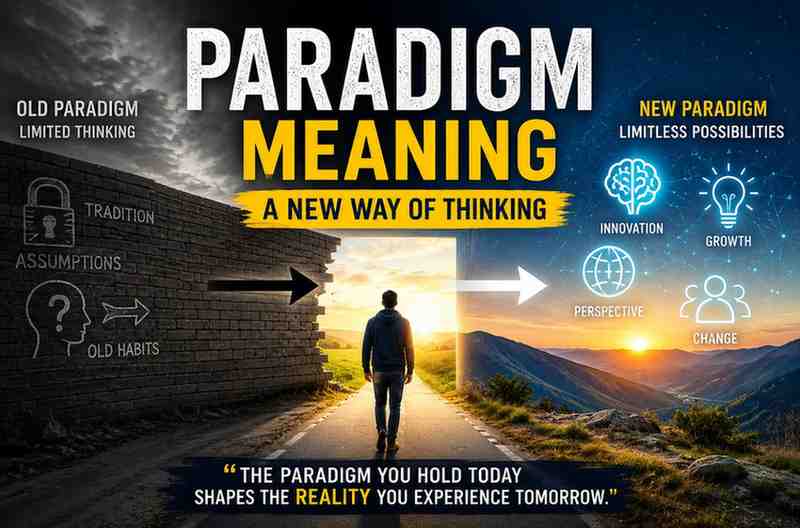
You sense the world isn’t working the way it used to. Ideas that once felt solid now buckle under new evidence. Yet most people cling to old maps while the territory has completely changed. Frustration grows when familiar rules fail. This guide strips away confusion. You will grasp the full paradigm meaning, see why mental models dictate every decision, and learn how to spot — and use — the shifts that redefine success.
What Is the Paradigm Meaning? A Clear Definition
The paradigm meaning refers to a shared set of assumptions, concepts, values, and practices that form a framework through which a community views reality. Think of it as the lens that filters what you notice and how you interpret it. Thomas Kuhn, the physicist and philosopher who gave the term its modern power, described a paradigm as “universally recognized scientific achievements that, for a time, provide model problems and solutions for a community of practitioners.”
Outside science, the paradigm meaning expands to any dominant worldview — in business, education, or personal habits — that dictates “the way things are done.” When you understand the paradigm meaning, you realize that truth often operates inside invisible boundaries. Those boundaries remain unquestioned until a critical mass of anomalies cracks them open.
- A paradigm shapes what you consider possible.
- It filters data, making some facts obvious and others invisible.
- Recognizing your own paradigm is the first step toward meaningful change.
The Origin of Paradigm: Thomas Kuhn’s Revolutionary Idea
Thomas Kuhn cemented the modern paradigm meaning in his 1962 book The Structure of Scientific Revolutions. He challenged the belief that science progresses smoothly by accumulation. Instead, he showed that science lurches forward through disruptive shifts — paradigm shifts.
Normal science, Kuhn argued, operates inside a settled paradigm. Researchers solve puzzles within agreed rules. But when too many anomalies pile up, the old paradigm cracks. A new one emerges, incompatible with the previous framework. This struggle gave the paradigm meaning its historical weight. Kuhn’s primary source remains the bedrock for understanding how entire fields of knowledge transform. His work highlights a truth most disciplines still resist: your core assumptions determine what you see as fact, and changing those assumptions feels like converting to a new religion, not simply learning a new fact.
Key Types of Paradigms in Everyday Life
The paradigm meaning isn’t locked in a philosophy seminar. It operates in multiple layers of daily existence. Recognizing the types of paradigms helps you spot their influence before they trap you.
- Scientific paradigms: The overarching theories that guide research (Newtonian physics, germ theory).
- Social paradigms: Shared beliefs about gender roles, work, and authority that dictate social norms.
- Cultural paradigms: Deeply embedded narratives that define a group’s identity, rituals, and taboos.
- Personal paradigms: Internalized stories about your capabilities, worth, and possibilities — often set in childhood.
- Business paradigms: Industry-wide assumptions about value creation, competition, and customer behavior.
Each layer imposes a filter. When the filter no longer matches reality, tension rises until a shift becomes inevitable. Understanding the paradigm meaning across these layers equips you to lead change rather than be blindsided by it.
Scientific Paradigms: From Newton to Einstein
Scientific paradigms offer the clearest illustration of the paradigm meaning. For two centuries, Newtonian mechanics dominated physics. Space and time were absolute, separate, and predictable. Scientists built careers refining that model.
But anomalies appeared — the orbit of Mercury, the behavior of light at high speeds — that Newton’s laws couldn’t explain. Einstein’s relativity didn’t tweak Newton; it replaced the underlying paradigm. Space and time became a unified fabric. Mass curved spacetime. What one paradigm called solid truth, the new one revealed as a special case. This dramatic replacement underscores the paradigm meaning: a paradigm isn’t just an idea; it’s the scaffolding of reality for those inside it. Kuhn’s original work shows that scientists often resist the new paradigm until the weight of evidence forces a shift.
- Old paradigm: Newtonian mechanics (absolute time, predictable clockwork universe).
- New paradigm: Einstein’s relativity (spacetime continuum, mass-energy equivalence).
- Shift driver: Unexplained anomalies that the old framework labeled errors.
Social and Cultural Paradigms That Shape Society
The paradigm meaning extends beyond laboratories. Social and cultural paradigms define what a society considers normal, fair, or sacred. For centuries, a cultural paradigm held that certain groups were naturally suited only for domestic roles. That paradigm wasn’t questioned; it was simply the water in which everyone swam. Shifts occurred when anomalies — suffrage movements, economic demands during wars, legislative breakthroughs — accumulated to the breaking point.
The rise of remote work shattered the corporate paradigm that productivity requires a shared physical office. These shifts demonstrate the paradigm meaning in action: a social paradigm feels like objective reality until a critical mass of people sees it as a choice. Understanding this prevents you from mistaking a temporary consensus for permanent truth.
Personal Paradigms: The Mental Frameworks You Live By
The most intimate application of the paradigm meaning is personal. Each person operates from an internal paradigm — a set of beliefs about identity, capability, and what they deserve. A person who grew up in scarcity often develops a paradigm of never enough: opportunities shrink, risks magnify, and success feels temporary.
Another person, shaped by a paradigm of growth, interprets setbacks as data, not verdicts. Personal paradigms function below conscious awareness. They create powerful confirmation loops. If your paradigm says “people can’t be trusted,” you’ll collect evidence for betrayal and ignore loyalty. The paradigm meaning here is urgent: your results rarely exceed the borders of your internal framework. Shifting a personal paradigm requires more than a motivational quote. It demands a disorienting encounter with counter-evidence until the old story breaks and a new one forms.
What Is a Paradigm Shift? Meaning and Stages
A paradigm shift is the replacement of one dominant framework with a fundamentally different one. The paradigm meaning includes the understanding that shifts rarely happen smoothly. Kuhn identified phases: normal science (puzzle-solving within the paradigm), anomaly accumulation, crisis, and then a revolutionary shift that redefines the field.
Once the shift happens, practitioners cannot return to the old way of seeing; the new paradigm makes the previous one look naive. This applies to science, organizations, and personal lives. The shift from typewriters to personal computers wasn’t an incremental upgrade. It rewired the paradigm meaning of writing, communication, and work itself. The process follows a pattern.
- Normal state: The current paradigm solves most problems.
- Anomaly build-up: Exceptions pile up, and the model strains.
- Crisis: Confidence erodes. Ad hoc patches fail.
- Shift: A new framework emerges, often from the fringe.
- New normal: The revolutionary paradigm becomes the new orthodoxy.
Famous Paradigm Shift Examples That Changed the World
History’s biggest disruptions clarify the paradigm meaning better than abstract theory. These examples show how a single shift reorders everything.
| Field | Old Paradigm | New Paradigm | Key Shift Driver |
| Astronomy | Geocentric (Earth at center) | Heliocentric (Sun at center) | Galileo’s observations |
| Medicine | Humoral theory (four humors) | Germ theory of disease | Pasteur’s experiments |
| Manufacturing | Craft production | Assembly line (Ford) | Efficiency demands |
| Communication | Postal mail and landlines | Internet and instant messaging | Digital packet switching |
| Energy | Fossil fuel dominance | Renewable decentralized grids | Climate pressure and cost parity |
Each case reveals the paradigm meaning as a shared truth that governed problem-solving, education, and investment — until it collapsed under the weight of better evidence.
Business Paradigms and Disruptive Innovation
In business, the paradigm meaning determines strategy, resource allocation, and competitive boundaries. Clayton Christensen’s disruptive innovation theory shows that industry leaders often fail not because of poor management but because they cling to a paradigm that defines what “good business” looks like. Blockbuster’s paradigm centered on physical rental stores and late fees.
Netflix’s paradigm prioritized streaming convenience and a subscription model. Blockbuster possessed the resources to pivot early, but its internal paradigm filtered out the threat as niche. Understanding the paradigm meaning in business reveals that your biggest risk is not a faster competitor but an invisible assumption that blinds you. Markets shift when the old definition of value no longer matches what customers actually want.
- Source: Harvard Business Review documented Netflix’s disruption as a classic paradigm trap for incumbents.
- Lesson: Audit your organization’s sacred cows quarterly.
- Actionable step: Identify the belief that “everyone in this industry knows is true” and test it against fresh data.
The Danger of Paradigm Paralysis (and How to Avoid It)
Paradigm paralysis occurs when a person or organization refuses to question a failing framework despite mounting evidence. The paradigm meaning includes the hard truth that the longer a paradigm serves you, the harder it is to release. Kodak invented the digital camera yet buried it because its paradigm equated profits with film. This paralysis is not stupidity; it is a cognitive survival mechanism. The brain favors consistency over accuracy. Avoiding paralysis requires deliberate practices.
- Seek out disconfirming evidence rather than reinforcement.
- Rotate team members into roles that force fresh perspectives.
- Schedule “pre-mortems” where you imagine your current paradigm has failed and work backward to discover why.
- Expose yourself to outsiders who hold no stake in your model.
Grasping the full paradigm meaning arms you with the humility to hold strong opinions loosely. The most dangerous sentence in any field is “that’s just how things work.”
How to Shift Your Own Paradigm for Personal Growth
Shifting a personal paradigm applies the paradigm meaning to your own life with radical honesty. Start by excavating the hidden belief that drives unwanted patterns. If you consistently undermine your own success, what is the underlying rule? Perhaps “people like me don’t get to have both wealth and integrity.” This rule was installed long ago by an authority figure or a painful experience.
To break it, you need an emotionally charged contradiction — a reference experience that proves the rule false. Neuroscience research shows that significant change requires the brain to reconsolidate memories in a new way. That means you must actively live out a counter-example, not just intellectualize it. A 2018 study in Frontiers in Psychology on cognitive flexibility confirms that repeated exposure to new frameworks rewires habitual thought patterns.
- Write down the unwanted result.
- Ask: What must I believe for this result to make sense?
- Identify the origin story of that belief.
- Design a small, safe experiment that contradicts it.
- Repeat until the old paradigm no longer feels like reality.
The Role of Paradigms in Education and Learning
Education systems operate on a deep paradigm meaning that defines knowledge, authority, and the purpose of schooling. The traditional paradigm treats the teacher as the keeper of knowledge and the student as an empty vessel to be filled. Grades measure compliance with that transfer. A newer paradigm views learning as co-creation, curiosity-driven, and competency-based. Finland’s education redesign challenged the old paradigm by eliminating standardized testing for younger students and prioritizing problem-solving.
The shift unsettled those who equated rigor with hours of direct instruction. But outcomes proved that the new paradigm produced engaged, adaptable thinkers. Education’s paradigm meaning will continue shifting as artificial intelligence personalizes learning and the value of memorized facts plummets. The learner who understands paradigms will adapt; the one who clings to a diploma as a lifetime credential will get left behind.
Future Paradigms: What’s Next for Humanity?
The next major shifts will rewrite the paradigm meaning of life, intelligence, and work. Several emerging transformations are already gathering anomalies.
- Biological paradigm: Moving from treating disease to programming biology via CRISPR and mRNA platforms.
- Intelligence paradigm: From human-only cognition to human-AI collaborative intelligence.
- Economic paradigm: From growth-at-all-costs GDP measures to well-being and regenerative metrics.
- Identity paradigm: From fixed national and demographic labels to fluid, self-sovereign digital identities.
- Energy paradigm: From centralized fossil grids to distributed clean microgrids.
Each of these challenges a deeply held assumption. The paradigm meaning in the future will not arrive by consensus. It will arrive through crisis, experimentation, and a generation that cannot see the world through the old lens. Preparing means learning to detect early anomalies and resisting the urge to mock what you cannot yet categorize.
Comparing Old and New Paradigms Across Fields
| Domain | Old Paradigm | New Paradigm | Signal of Shift |
| Health | Treat symptoms reactively | Optimize whole system preventively | Rise of functional medicine |
| Work | Fixed location, 9-to-5 | Output-based, location-flexible | Widespread remote collaboration |
| Learning | Degree-centered, early life | Lifelong, skill-based micro-credentials | Digital badges, bootcamps |
| Finance | Centralized banking | Decentralized finance (DeFi) | Blockchain adoption |
| Environment | Infinite resource exploitation | Circular regenerative economy | Net-zero commitments |
Frequently Asked Questions
What is the paradigm meaning in simple words?
The paradigm meaning in simple terms is a shared mental model — a set of rules and beliefs that a group uses to understand the world and decide what is true or possible.
Who introduced the paradigm meaning and concept of paradigm shifts?
Thomas Kuhn introduced the modern paradigm meaning and the concept of paradigm shifts in his 1962 book The Structure of Scientific Revolutions, a primary source still widely cited in philosophy and social sciences.
How does the paradigm meaning apply to personal life?
Your personal paradigm meaning is the invisible story you hold about who you are, what you deserve, and what you can achieve. It filters experiences and drives behavior until you consciously challenge it.
Can you give an example of the paradigm meaning in business?
A classic example of the paradigm meaning in business is Netflix disrupting Blockbuster. Blockbuster’s paradigm defined video rental through physical stores; Netflix redefined it around streaming and subscription, collapsing the old framework.
Why is understanding paradigm meaning important for innovation?
Without grasping the paradigm meaning, teams optimize inside a dying framework. Innovation stalls when you mistake the paradigm’s limits for reality’s limits. Recognizing it opens space for breakthrough products and strategies.
Is the paradigm meaning the same as a mindset?
Related but not identical. A mindset is an individual’s attitude. The paradigm meaning is a shared, systemic framework that shapes what a whole community considers legitimate. A paradigm creates the field within which individual mindsets operate.