
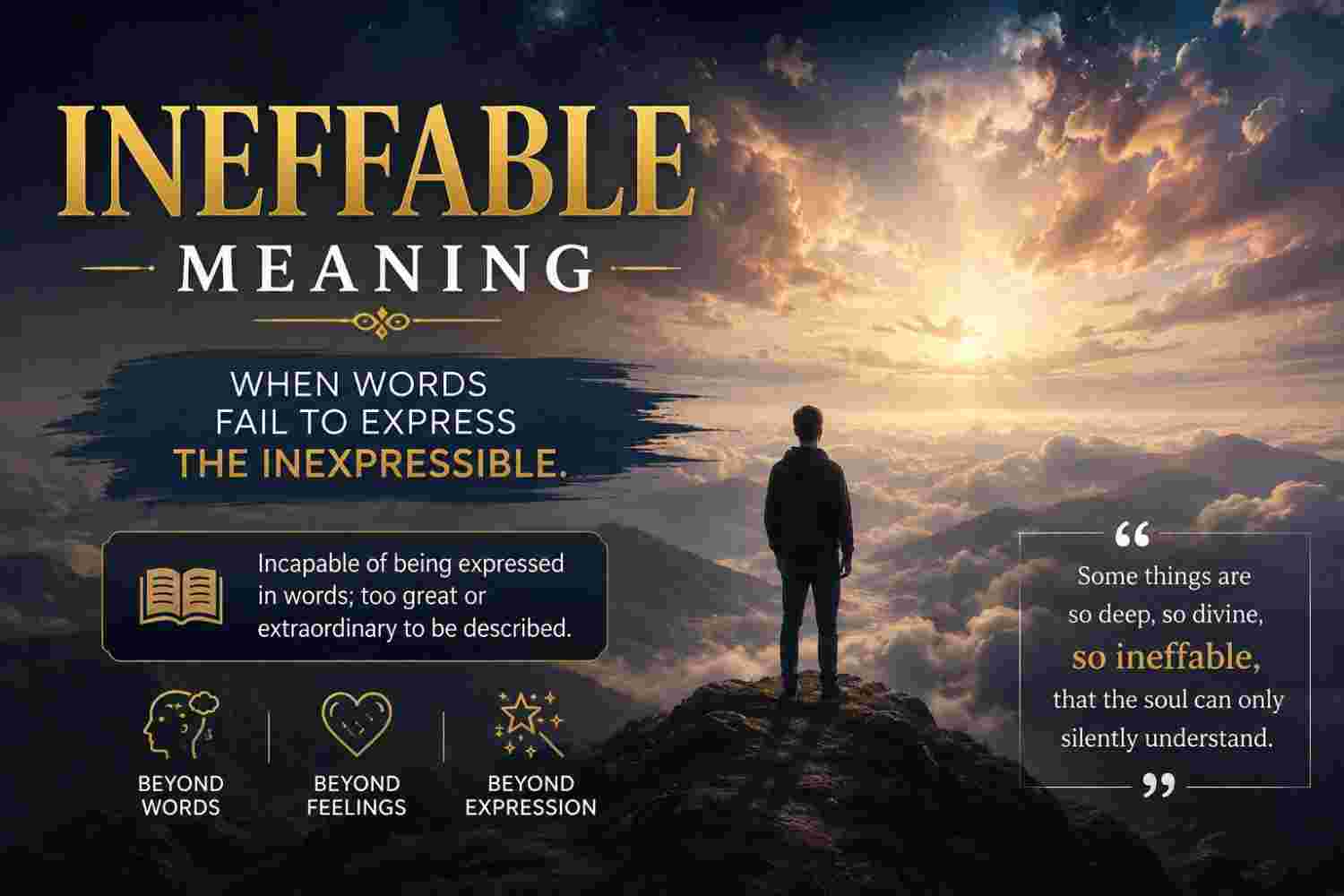
Can you recall a moment so beautiful, painful, or sacred that no words felt adequate? That exact struggle has a name. The ineffable meaning points to experiences beyond normal description. This guide gives you a clear definition, rich examples, and confident usage. You will never confuse it with ordinary synonyms again.
What Does Ineffable Mean?
The ineffable meaning is simple: too great, extreme, or sacred to be expressed in words. Merriam-Webster defines ineffable as “incapable of being expressed in words.” The Oxford English Dictionary adds “too great or extreme to be expressed or described in words.” Use this adjective for experiences that leave you speechless.
Ineffable Meaning: Word Origin and Etymology
The word comes from Latin ineffabilis. It combines *in-* (not) with effabilis (speakable), from effari (to speak out). This origin explains the ineffable meaning at its root: “not speakable.” French carried the word into Middle English. Understanding the Latin root helps you remember the word.
How to Pronounce Ineffable Correctly
Pronounce ineffable as /ɪnˈɛfəbəl/ (in-EF-uh-buhl). Break it into four parts: in, ef, uh, buhl. Stress the second syllable. Saying it aloud helps anchor the ineffable meaning.
Ineffable Synonyms and Antonyms
The ineffable meaning overlaps with several words, but each carries a different shade. Use this table to choose the right term.
| Word | Meaning | Strength or Nuance |
|---|---|---|
| Indescribable | Cannot be described | Common, everyday |
| Unspeakable | Too bad or awful to speak | Often negative |
| Unutterable | Too deep for words | Poetic, emotional |
| Inexpressible | Cannot be expressed | Broad, neutral |
| Sublime | Elevated, awe-inspiring | Positive, aesthetic |
Antonyms include expressible, describable, speakable, and utterable.
Ineffable vs. Inexplicable: Key Differences
Ineffable means language cannot capture the quality or intensity. Inexplicable means you cannot explain the cause or reason. A sunset can be ineffable in beauty but not inexplicable, because the cause is known. The ineffable meaning focuses on limits of expression, not logic.
Ineffable Meaning in Philosophy
Philosophy uses ineffable for truths beyond conceptual language. Plato described the Form of the Good as beyond being and description. Plotinus called the One ineffable. Stanford Encyclopedia of Philosophy notes that ineffability appears when language reaches its outer limit. These traditions shape the ineffable meaning.
Ineffable Meaning in Religious and Mystical Texts
Mystics across traditions describe the divine as ineffable. Thomas Aquinas wrote that God is ineffable because finite words cannot contain infinite reality. Jewish, Christian, Islamic, and Hindu mystics all use similar language. This sacred usage deepens the ineffable meaning.
Ineffable in Literature and Poetry
Poets lean on ineffable to signal transcendent feeling. William Wordsworth called a “sense sublime” something far more deeply interfused. C.S. Lewis wrote about joy as an unsatisfied desire for something beyond the world. These examples show the ineffable meaning in action.
How to Use Ineffable in a Sentence
The ineffable meaning becomes clear when you see the word in context. Use it before nouns to describe feelings, beauty, peace, or loss.
- The ineffable beauty of the mountain sunrise silenced the entire group.
- After the birth of her daughter, she felt ineffable joy.
- The music created an ineffable sense of longing.
- He described the loss as an ineffable ache.
Common Phrases with Ineffable
These phrases show the ineffable meaning in everyday writing:
- Ineffable joy
- Ineffable beauty
- Ineffable peace
- Ineffable mystery
- Ineffable sadness
- Ineffable love
Why Ineffable Experiences Matter
Naming the word ineffable validates moments that outrun language. Psychologist William James studied mystical experiences and noted their noetic quality and ineffability. Recognizing the ineffable meaning helps you honor awe, grief, and love without forcing them into small boxes.
Tips for Remembering This Word
- Link the prefix *in-* to “not.”
- Connect effable to “fable” or “speak.”
- Memorize the phrase “too deep for words.”
- Use it once in a sentence today.
Frequently Asked Questions About This Word
What is the ineffable meaning in simple words?
The ineffable meaning is the quality of being too great, intense, or sacred to put into words.
How do you use ineffable in a sentence?
Say “The view brought an ineffable sense of calm.” The ineffable meaning works best before nouns like joy, beauty, or peace.
What is the difference between ineffable and unspeakable?
Ineffable often points to positive or awe-filled experiences. Unspeakable usually signals something terrible. Context matters more than the word itself.
Does ineffable always have religious meaning?
No. This word appears in philosophy, literature, and everyday speech. It often describes religious awe, but you can use it for art, nature, or love.
Is ineffable a positive or negative word?
It is neutral. Context determines whether ineffable describes joy or grief.
What part of speech is ineffable?
Ineffable is an adjective. It modifies nouns such as beauty, peace, or mystery.