
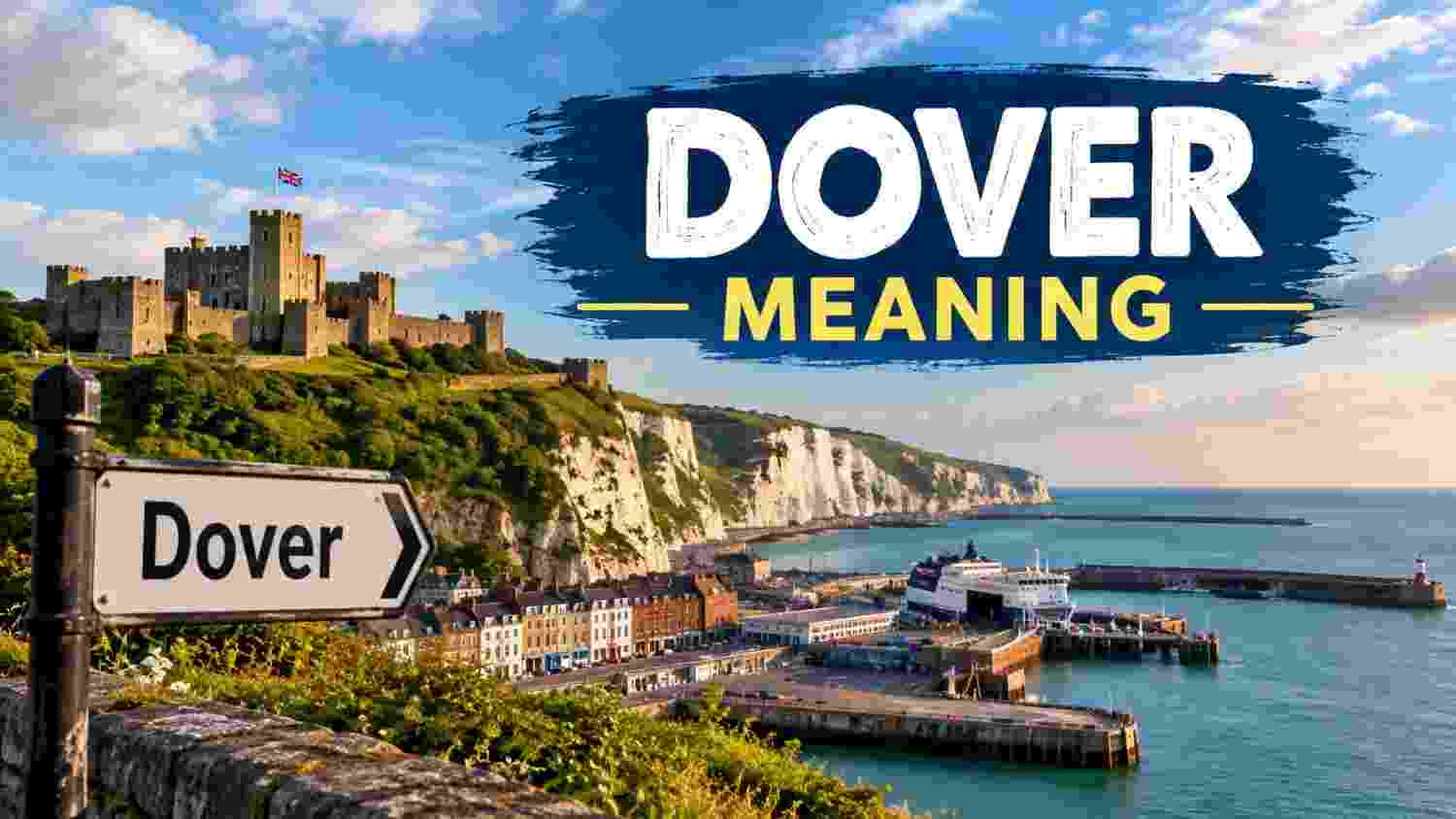
Most people assume Dover is just a ferry port with big white cliffs. That guess is wrong by roughly two thousand years.
The word carries a meaning older than England itself, older than the English language, and older than the castle standing above the harbour. Once you know what it actually says, you will hear it differently forever.
This guide breaks down the real Dover meaning, its Celtic root, the surname story, the famous fish, the American cities, and the slang usage people quietly giggle about. No fluff, no recycled dictionary lines.
What Does Dover Actually Mean?
Dover means “the waters” — and that translation comes straight from an ancient Celtic word, not from English.
The root is dubrās (also written dubras or dubro), a Brittonic Celtic term for water or streams. Roman scribes wrote it as Dubris in the 4th century, and Old English speakers later shaped it into Dofras around the year 700.
Here is the detail almost every blog post skips: the “waters” in question were never the English Channel. They referred to the small freshwater streams tumbling down the valley toward the harbour — the River Dour, which still runs through the town today.
The Celtic Thread That Never Broke
That same root survives in living languages. Welsh speakers say dŵr for water, and Cornish and Breton carry close cousins of the word.
Welsh linguist Guto Rhys recently made the point sharply in a viral explainer: ask for dŵr in Wales today and you are using the same word buried inside Dover. English place names like Wendover and Candover hide the identical element.
So when someone asks what Dover means, the honest answer is short. It is a two-thousand-year-old way of saying at the streams.
How the Word Changed Over Time
| Period | Recorded Form | Language / Source | Meaning Carried |
|---|---|---|---|
| Pre-Roman | dubrās | Brittonic Celtic | The waters, streams |
| c. 300s CE | Dubris | Latin (Roman records) | Place at the waters |
| c. 700 CE | Dofras | Old English | The waters |
| Middle Ages | Dovere | Middle English | Port settlement |
| Modern day | Dover | English | Town, surname, given name |
Look at the pattern in that table. The “b” softened into a “v”, the Celtic ending dissolved, and the plural sense quietly disappeared — yet the core sound survived every invasion England went through.
That kind of survival is rare. Roman, Saxon, Viking and Norman rulers all passed through Kent, and none of them managed to replace the original water-word.
Dover, Kent: The Town That Gave the Word Its Fame
The Kent port turned a local stream name into a global brand. It sits 21 miles from Cap Gris-Nez in France, the narrowest crossing point of the English Channel.
Roughly 44,000 people live in the town itself, while the wider Dover district holds around 118,000 residents. The Port of Dover handled about 9.13 million passengers in 2025, down slightly from 9.35 million in 2024.
Those chalk cliffs did the rest of the marketing. White, vertical and visible from France, they made Dover shorthand for “arriving home” in British wartime songs and letters.
Why the Port Numbers Matter
| Year | Passengers | Tourist Vehicles | Freight Vehicles |
|---|---|---|---|
| 2019 | 10,863,262 | 2,000,966 | 2,397,270 |
| 2022 | 6,559,169 | 1,246,153 | 1,997,458 |
| 2023 | 8,866,378 | 1,575,528 | 2,150,932 |
| 2024 | 9,351,348 | 1,726,911 | 2,164,370 |
| 2025 | 9,128,648 | 1,698,337 | 2,119,030 |
Read those rows as a recovery story with a ceiling. Passenger traffic climbed hard after the 2020–2022 collapse, then flattened below pre-2019 levels.
Freight tells a calmer tale — lorries kept rolling even in the worst years, which is exactly why the “waters” of Dover still anchor a huge slice of UK–EU trade.
Dover as a Surname: Where Families Got the Name
Dover works as a toponymic surname, meaning it was handed to people based on where they came from rather than what they did.
English families named Dover usually trace back to the Kent port or to a smaller Dover near Wigan in Lancashire. Records place the surname in England from the 12th century onward, and it became visible in American records by the 1700s.
There is a second route entirely. Some Irish bearers carry an anglicised form of Ó Dubhuidhir or Mac Duibhidhir, names otherwise rendered as Dwyer.
Quick Facts: The Dover Surname
| Detail | Information |
|---|---|
| Name type | Toponymic (place-based) surname |
| Language family | Celtic root, English usage |
| Core meaning | “The waters” |
| First records | England, 12th century |
| Irish variant | Anglicised Ó Dubhuidhir / Mac Duibhidhir |
| German link | Doveren, Rhineland (uncertain origin) |
| Common regions | England, USA, Ireland, Germany |
German-speaking Dovers often connect to Doveren in the Rhineland, and some Americanised spellings came from the surname Dauer. A single surname, three separate doors.
Dover Sole: Why a Fish Borrowed a Town’s Name
Solea solea is a European flatfish with no birth certificate from Kent. It swims from Norway down to the Mediterranean.
The name stuck for a commercial reason. In the 1800s, Dover’s fishing fleet supplied more of this fish to London’s Billingsgate market than anyone else, with stagecoaches running the catch up to the capital daily.
Speed built the reputation. Fresher fish meant better plates, so “Dover sole” became chef shorthand for premium sole — and it still commands top pricing on menus today.
- Solea comes from Latin for sandal, describing the flat shape
- Also sold as common sole across Europe
- Pacific Dover sole is a different species with a borrowed name
- It was the star fish course of Victorian and Edwardian dining
The Other Dovers on the World Map
William Penn named Delaware’s capital after the Kent port, and the name spread from there across the United States.
| Place | Location | Notable For |
|---|---|---|
| Dover | Kent, England | Port, castle, white cliffs |
| Dover | Delaware, USA | State capital, ~40,191 residents (2024) |
| Dover | New Hampshire, USA | One of the oldest US settlements |
| Dover | Ohio, USA | Tuscarawas County town |
| Dover AFB | Delaware, USA | Major Air Mobility Command cargo hub |
Notice how every American Dover inherited a meaning about Kentish streams it never had. Names travel faster than their definitions.
Dover in Slang and Pop Culture
Two usages float around online, and both deserve a straight answer.
“The pros from Dover” comes from the 1968 novel M*A*S*H, where Hawkeye bluffed his way onto golf courses by claiming to be a visiting golf pro. Americans now use it for outside consultants brought in to fix a mess.
The second is the “Ben Dover” wordplay — a childish pun, not a meaning. If you are researching the name seriously, ignore it.
Dover as a Baby Name in 2026
Parents hunting for surname-style first names keep circling Dover. It fits the trend that gave us Carter, Parker and Sawyer.
It stays far outside the US top 1,000, where Liam and Olivia still dominate. That rarity is the selling point for many families.
- Style: unisex, leans masculine
- Meaning for a child: “the waters” — calm, flowing, resilient
- Nicknames: Dov, Dove, Dov-Dov
- Watch out for: the bend-over pun on playgrounds
Frequently Asked Questions
What is the literal meaning of Dover?
Dover literally means “the waters”. It comes from the Brittonic Celtic word dubrās, which described the streams flowing through the valley to the harbour, not the sea.
Is Dover an English or Celtic name?
The name is Celtic in origin and English in usage. Celts named the place first, Romans recorded it as Dubris, and Old English speakers reshaped it into Dofras by around 700 CE.
What does the surname Dover mean?
The surname marks someone from a place called Dover — most often the Kent port or the Lancashire village. It signals geography, not occupation or ancestry.
Why is it called the Strait of Dover?
The strait takes its name from the town facing France at the Channel’s narrowest point, 21 miles across. The waterway borrowed the town’s name, not the reverse.
Is Dover a good name for a baby?
It works well if you want a rare, place-based name with a gentle meaning. Test it aloud with your surname first, since the playground pun is real.
Why is Dover sole called Dover sole?
Dover’s fleet landed the freshest sole for London markets in the 1800s. The port name became a quality label and stayed attached to the fish.
Does Dover mean anything in other languages?
The root survives as dŵr in Welsh and related forms in Cornish and Breton, all meaning water. In modern English, Dover functions purely as a name.
The Final Verdict on Dover
Strip away the castle, the ferries and the cliffs, and you are left with a small crowd of Iron Age people naming a spot after running water. That is the whole story.
Here is my insider tip for writers, parents and genealogists alike: whenever you meet an old British place name starting with dov, dour, dwr or dever, check for water nearby. You will be right more often than you expect.
Dover survived Romans, Saxons, Normans and two world wars with its meaning intact. Few words in English can claim that kind of record.