
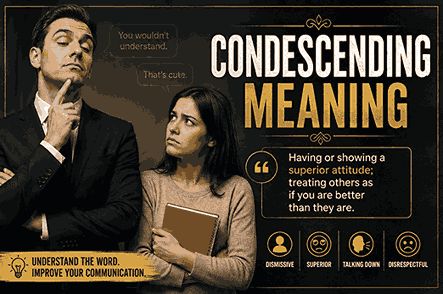
You walk away from a chat feeling two inches tall, but you can’t put your finger on why. The words seemed polite. The smile never cracked. Yet somehow you feel disrespected. That knot in your stomach? It’s your gut decoding the real condescending meaning long before your brain catches up.
Most articles hand you a dry dictionary line and call it a day. That’s useless when you’re sitting across from a coworker who treats you like a slow student. Here, you’ll get the full emotional mechanics of condescension, seven secret signs that hide in plain sight, and exact scripts to shut it down without burning bridges. No fluff. No academic mumbling.
The Real Condescending Meaning (And Why Dictionaries Miss the Point)
Google will tell you condescending means “having or showing a feeling of patronizing superiority.” That’s accurate, but incomplete. Condescending meaning lives in the gap between what’s said and what’s actually communicated through tone, timing, and body language.
Think of it as verbal quicksand. On the surface, the sentence looks stable. Underneath, there’s an unspoken message: I’m up here, you’re down there, and I’m generous enough to speak at your level. That underlying hierarchy is the real weapon. It can arrive dressed as help, humor, or even concern, which makes it dangerously invisible until your confidence starts eroding.
Psychologists define condescension as a subtle form of social put-down that preserves the speaker’s plausible deniability. The genius—and cruelty—of it is that if you call it out, you risk sounding “too sensitive.” That’s why understanding condescending meaning requires reading what’s not being said, not just the transcript.
The Three Layers of a Condescending Message
If you only listen to the words, you’ll miss 80% of the insult. Every condescending remark carries three layers:
- The text: The literal words (“Let me explain this slowly”).
- The subtext: The implied status imbalance (“You’re not smart enough to keep up”).
- The social shield: The exit strategy (“I was only trying to be clear!”).
That third layer is why condescending behavior survives in workplaces and relationships for years. It’s an invisible jab wrapped in a Kevlar vest of good intentions.
Condescending vs. Patronizing: The Difference That Changes Everything
People use these terms interchangeably, but they’re not identical. Grasping the nuance will make you dramatically better at naming what you’re experiencing.
Patronizing behavior is a close cousin. It also involves treating someone as inferior, but it often comes with a flavor of fake kindness or pity. Condescension, by contrast, leans more on overt intellectual or status superiority. A patronizing boss says, “Don’t worry your pretty little head about the budget.” A condescending boss says, “I’ve been doing this for 20 years, so just trust me—you wouldn’t understand the nuances.”
Here’s a simple table to lock it in:
| Behavior | Core Message | Tone |
|---|---|---|
| Condescending | I’m smarter or higher-status than you. | Cool, aloof, often humorless. |
| Patronizing | I feel sorry for your limited ability. | Sweet, pitying, “kind” on the surface. |
| Both | I’m above you, and I want you to feel it. | Undermining, diminishing. |
Knowing this distinction isn’t just vocabulary nerdiness. It changes how you respond. If someone is patronizing, you can address the fake sympathy. If they’re being condescending, you target the arrogance directly.
7 Secret Signs of Condescending Behavior You’re Probably Missing
Most people wait for a blatant insult to feel justified in being upset. But condescending meaning hides in micro-moments that are easy to gaslight yourself about. Watch for these seven patterns—they’re the canaries in the coal mine.
1. The Compliment Sandwich That Bites
A genuine compliment sandwich builds someone up. A condescending one does the opposite. It sounds like: “You’re so articulate for someone with your background.” Or: “Wow, you actually handled that meeting really well.” The tiny qualifiers for someone and actually reveal the speaker’s baseline assumption: they expected less from you.
The compliment is just the carrier wave for the insult.
2. The Over-Explanation You Never Asked For
You mention a concept you clearly understand, and they launch into a grade-school breakdown as if you’ve never heard of it. They’ll say, “Let me break this down for you” when no breakdown was requested. The hidden script is: “I assume you’re starting from zero, because that’s how I see you.” This often targets women and younger colleagues in professional settings.
3. The “Helpful” Public Correction
This one thrives in meetings. You say something insightful, and a peer chimes in with, “Actually, what I think Sarah means is…” and then restates your point slightly reworded. The correction didn’t change the meaning—it just repositioned them as the translator of your inadequate thoughts. It’s a dominance play dressed as assistance.
4. The Fake Sympathy Voice
It’s the vocal equivalent of a pat on the head. The pitch drops or becomes syrupy slow. Statements like, “Aww, you tried your best” or “That’s cute that you think that” don’t need aggressive words to land as insults. The condescending meaning is carried entirely by the tone, which makes it maddeningly hard to explain to others.
5. The Group Dismissal Tactic
Someone makes a point, and the condescending person looks around the room with a smirk, as if inviting others to share a private joke at your expense. They might not say a word. That shared glance is a loudspeaker announcement: “We all know this person isn’t on our level.” It’s a silent but devastating form of social exclusion.
6. The “I’m Just Being Honest” Shield
You hear things like, “No offense, but…” or “I tell it like it is.” What follows is a blunt, often cruel assessment delivered with zero regard for your feelings. The speaker uses “honesty” as armor to avoid accountability for being a jerk. Genuinely honest people don’t need to advertise it; they deliver truth with care, not a battering ram.
7. The Body Language Betrayal
Words can lie; the body rarely does. Look for these physical giveaways of condescension:
- Looking down the nose or tilting the head back while speaking.
- A one-sided smirk or a tight, dismissive lip purse.
- Interrupting you by raising a palm, like a traffic cop stopping a car.
- Busying themselves with a phone or papers while you’re making a point.
When words and body don’t match, trust the body. It’s the unfiltered expression of the condescending meaning the speaker won’t say out loud.
The Psychology Behind Condescension: Why People Talk Down to You
Understanding the why doesn’t excuse the behavior, but it strips the behavior of its power over you. Most condescending people aren’t mustache-twirling villains; they’re operating from insecurity, habit, or social clumsiness.
Psychologists point to three main drivers. First, status insecurity: people who feel their position is shaky often puff themselves up by pushing others down. A mid-level manager who lacks real authority might overcompensate with a condescending tone. Second, learned behavior: many grew up in households where intellectual snobbery or sarcastic put-downs were the norm. They genuinely believe this is how smart people communicate. Third, lack of empathy: some individuals simply can’t read the emotional impact they’re having, or they don’t care to.
Here’s a glance at how widespread the impact is:
| Condescension in Numbers | Statistic |
|---|---|
| Employees who hear condescending language weekly | 41% (2024 Workplace Communication Index) |
| Managers who admit using “dumbed-down” language with some team members | 27% |
| People who’ve left a job citing a condescending manager as the top reason | 33% |
| Relationships where condescension is a core conflict factor | 58% (Gottman Institute study) |
The numbers scream one truth: condescension isn’t a minor annoyance. It’s a relationship and career killer that flies under the radar precisely because it’s hard to articulate.
How to Respond to Condescending Remarks Without Losing Your Cool (or Your Job)
You don’t need to start a war. The goal is to make the dynamic visible in a way that protects your dignity and leaves the other person with nothing to grab onto. Use these situational strategies.
The Calm Clarification Method
When someone over-explains or talks down to you, respond with a neutral, curious tone: “I appreciate the detail. Which part made you think I needed the basics re-explained?” This isn’t aggressive—it’s a mirror. It forces them to either admit the condescension or backpedal gracefully. Most choose the latter.
The “I’m Confused” Redirect
For public corrections, try: “I’m a bit confused—that sounds exactly like what I just said. Can you point out the difference?” Delivered with genuine curiosity, it removes their cloak of helpfulness and exposes the redundancy. You’re not accusing; you’re inviting clarification. It’s devastatingly effective.
The Strategic Ignore
Not every condescending slight deserves your energy. If it’s a one-off from a generally good person, simply proceed as if they spoke to you as an equal. Reply substantively to the real topic, completely bypassing the condescending packaging. This starves the behavior of the reaction it seeks.
When It’s a Pattern: The Private Boundary
For colleagues or friends who repeatedly use condescending language, pull them aside privately. Say, “When you use phrases like X, I think you might not realize how they land. I’m telling you directly because I value our working relationship.” This signals emotional maturity and often earns respect, even if they get defensive at first.
The Hidden Cost of Chronic Condescension in Relationships and Work
You might think letting it slide keeps the peace. The data says otherwise. In romantic partnerships, condescension is one of the Four Horsemen of relationship apocalypse according to relationship expert John Gottman, right alongside contempt. It slowly poisons respect. At work, teams with a condescending culture see higher turnover, lower psychological safety, and a 40% drop in collaborative problem-solving.
The most insidious cost is self-doubt. When you’re marinated in condescending meaning daily, you start to internalize it. You speak up less. You question your own competence. You start prefacing ideas with “This might be stupid, but…” That’s the real damage. Recognizing the pattern is how you stop handing over the keys to your confidence.
Frequently Asked Questions
What is the exact meaning of condescending?
Condescending means treating someone with an attitude of superiority, as if you are lowering yourself to their level. It’s a communication style where the speaker implies they are smarter, more important, or more capable than the listener, often through tone, word choice, or dismissive body language.
How do you know if someone is being condescending or just direct?
Direct communication is clear and respectful, focused on the issue, not the person’s perceived rank. Condescending communication carries a sense of looking down. If you feel smaller or belittled after the exchange, and there’s a noticeable tone of arrogance or impatience, you’re likely dealing with condescension—not just bluntness.
What’s the difference between condescending and patronizing?
Condescending behavior emphasizes intellectual or status superiority (“I know better”). Patronizing behavior often mixes a feeling of pity with fake kindness, treating the other person as helpless or childlike. Both put the speaker above the listener, but patronizing wears a sweeter mask.
Can condescending behavior be unintentional?
Yes. Many people use condescending language out of habit, cultural conditioning, or because they genuinely think they’re being helpful. However, impact matters more than intent. If you repeatedly make people feel small, it’s your responsibility to adjust, whether you meant to or not.
How do I stop being condescending myself?
Start by checking your assumptions about others’ knowledge before you speak. Replace “Let me explain” with “What’s your take on this?” Listen more than you talk. Record yourself in conversations and listen for a tone of superiority. Ask trusted friends to flag moments you slip—it’s humbling but transformative.
What are some examples of condescending phrases?
Common ones include: “Calm down,” “You wouldn’t understand,” “Actually…” (as a constant corrector), “I’ll simplify this for you,” “That’s a good effort for a first try,” “You’re so cute when you’re passionate about this,” and “Anyone with experience knows…”
How do you deal with a condescending boss?
Use calm, professional deflection. Acknowledge their input briefly, then pivot back to the work: “I hear your perspective. Let’s focus on the deliverable—here’s my plan to move forward.” Document patterns if it becomes toxic. Privately, you can say, “I work best with direct feedback that doesn’t assume my level of understanding.” This draws a boundary without escalating.
Reclaim Your Ground: The Final Word
You’ve decoded the condescending meaning that once flew under your radar. Those subtle smirks, over-explanations, and “helpful” public corrections can no longer hide behind good intentions. Knowledge here is power—but only if you use it. Next time someone tries to shrink you with a patronizing tone, you’ll recognize it instantly. You’ll have the words and the unshakeable calm to respond in a way that preserves your dignity and resets the balance.