
Introduction
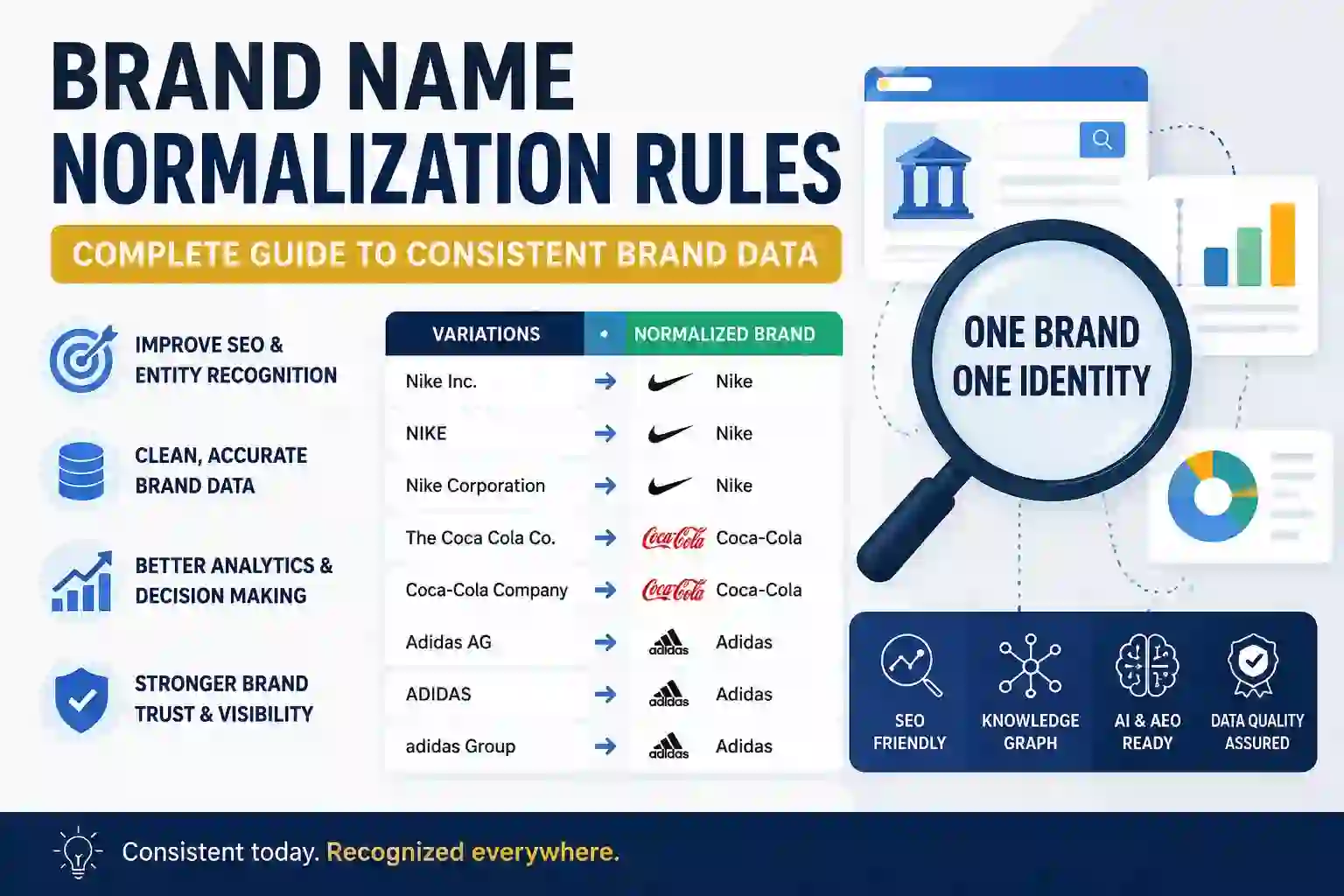
A single brand can appear in many different ways across websites, databases, marketplaces, and search engines. “Nike Inc.”, “NIKE”, and “Nike” may represent the same entity, but inconsistent naming creates confusion for users, businesses, and search systems. Brand name normalization rules help organizations create accurate, consistent brand identities that improve search visibility, data quality, and customer trust.
What Are Brand Name Normalization Rules?
Brand name normalization rules are structured guidelines used to standardize different versions of a brand name into one consistent format. These rules help businesses, search engines, databases, and AI systems understand when multiple names refer to the same brand entity.
For example:
| Original Brand Name | Normalized Brand Name |
|---|---|
| Apple Inc. | Apple |
| APPLE | Apple |
| Apple Computer Company | Apple |
| Coca Cola Co. | Coca-Cola |
| Adidas AG | Adidas |
The purpose is not to change a company’s official identity. Instead, normalization removes unnecessary variations while preserving the recognized brand entity.
Brand normalization is widely used in:
- SEO entity optimization
- Product databases
- Customer relationship management systems
- Marketplaces
- Knowledge graphs
- Artificial intelligence systems
- Data analytics platforms
Why Are Brand Name Normalization Rules Important?
Businesses collect brand information from thousands of sources. Without consistent naming standards, the same brand can appear as multiple separate entities.
This creates problems such as:
- Duplicate records
- Incorrect analytics
- Poor search understanding
- Broken product relationships
- Reduced customer trust
For SEO, consistent brand signals help search engines connect mentions, reviews, products, and authoritative information to the correct entity.
Google uses entities to understand people, organizations, places, and concepts. Clear brand signals can support better understanding across search experiences.
How Do Brand Name Normalization Rules Work?
A normalization process usually follows several steps:
Brand Name Collection
The first step is gathering all brand variations from different sources.
Common sources include:
- Websites
- Product feeds
- Social media profiles
- Business directories
- Marketplaces
- Internal databases
Example:
A company database may contain:
- Samsung Electronics
- Samsung Electronics Co Ltd
- SAMSUNG
- Samsung
All variations are collected before cleaning.
Identify Brand Variations
The system analyzes differences between names.
Common variations include:
| Variation Type | Example |
|---|---|
| Capitalization differences | NIKE / Nike |
| Legal suffixes | Tesla Inc. / Tesla |
| Spacing differences | Coca Cola / Coca-Cola |
| Abbreviations | International Business Machines / IBM |
| Regional naming | Google LLC / Google |
| Typing errors | Amazn / Amazon |
Apply Normalization Rules
After identifying variations, predefined rules decide the final brand format.
Common rules include:
Remove Legal Business Suffixes
Remove unnecessary company endings:
- Inc.
- LLC
- Ltd.
- Corporation
- PLC
Example:
Before:
Microsoft Corporation
After:
Microsoft
Standardize Capitalization
Use the official brand style.
Examples:
Incorrect:
ADIDAS
Normalized:
Adidas
Incorrect:
apple
Normalized:
Apple
Preserve Official Brand Formatting
Some brands require special formatting.
Examples:
- eBay
- iPhone
- YouTube
Normalization should respect official brand guidelines.
Complete Brand Name Normalization Rules Table
| Rule | Purpose | Example Before | Example After |
|---|---|---|---|
| Remove legal suffixes | Remove unnecessary company terms | Meta Platforms Inc. | Meta |
| Fix capitalization | Create consistent formatting | ||
| Remove extra spaces | Improve matching | Face book | |
| Correct punctuation | Standardize writing | Coca Cola | Coca-Cola |
| Remove duplicate words | Avoid repeated entries | The Nike Nike Store | Nike Store |
| Correct spelling errors | Improve accuracy | Amazone | Amazon |
| Maintain official names | Protect brand identity | Linked In |
Brand Name Normalization Rules for SEO and Google Search
SEO depends heavily on clear entity understanding.
Search engines analyze:
- Brand mentions
- Website information
- Structured data
- Reviews
- External references
- Business profiles
When a brand appears consistently, search engines can build stronger connections between different signals.
For example:
A company appearing as:
- ABC Technologies
- ABC Tech LLC
- ABC Technology Solutions
may create uncertainty.
Using proper brand name normalization rules ensures all mentions connect to one recognized entity.
Benefits include:
- Better brand entity recognition
- Cleaner structured data
- Improved knowledge graph signals
- More accurate search results
- Stronger online reputation
How Brand Normalization Improves AI Search and AEO
AI search systems depend on accurate information relationships.
Platforms using artificial intelligence analyze:
- Entities
- Relationships
- Context
- Brand authority
Incorrect brand naming can confuse AI systems.
For example:
A user asks:
“Who owns WhatsApp?”
AI systems need to understand:
- WhatsApp Inc.
- Meta Platforms
are connected entities.
Consistent naming improves:
- AI-generated answers
- Voice search accuracy
- Brand discovery
- Digital assistants’ understanding
Brand Name Normalization Rules for Ecommerce Product Data
Ecommerce websites often face thousands of brand variations.
A product catalog may include:
| Product Entry | Problem |
|---|---|
| Apple Inc | Legal suffix |
| APPLE | Capital variation |
| Apple Computer | Old name |
| Apple® | Trademark symbol |
A normalized catalog creates:
Apple
This improves:
- Product filtering
- Internal search
- Marketplace accuracy
- Customer experience
Large marketplaces such as Amazon and Google depend on clean structured data to connect products and entities.
Brand Name Normalization vs Brand Name Standardization
These concepts are related but different.
| Feature | Normalization | Standardization |
|---|---|---|
| Goal | Remove variations | Create a preferred format |
| Focus | Data accuracy | Brand consistency |
| Used in | Databases, SEO, AI | Marketing, branding |
| Example | Nike Inc → Nike | Always write Nike |
Normalization prepares data. Standardization maintains consistency.
Many organizations use both together.
Best Practices for Creating Brand Name Normalization Rules
Create an Official Brand Dictionary
Maintain a central database containing:
- Approved brand name
- Previous names
- Abbreviations
- Country variations
- Parent company information
Example:
| Field | Value |
|---|---|
| Official Name | Microsoft |
| Former Name | Microsoft Corporation |
| Category | Technology |
| Parent Company | Microsoft |
Use Human Review for Important Brands
Automated systems can identify patterns, but human review protects against mistakes.
Special attention is needed for:
- Luxury brands
- Global companies
- Technology products
- Similar brand names
Connect Brands With Entities
A normalized brand record should include:
- Official website
- Social profiles
- Company description
- Industry category
- Organization schema
This creates stronger entity signals.
Tools Used for Brand Name Normalization
Companies commonly use:
- Data cleansing platforms
- Product information management systems
- CRM databases
- AI entity matching tools
- Natural language processing systems
Popular technologies include:
- Machine learning matching
- String similarity algorithms
- Knowledge graphs
- Rule-based validation
Common Mistakes in Brand Name Normalization
Removing Important Brand Identity
Changing:
eBay
into:
Ebay
can damage official branding.
Ignoring Historical Brand Names
Old company names may still have valuable search connections.
Example:
Google was previously connected with Google Inc.
Historical relationships should be preserved.
Over-Automating Without Review
AI can detect patterns, but unusual brand names often require expert decisions.
How to Build a Brand Name Normalization Workflow
A simple workflow:
- Collect brand data from all sources.
- Detect duplicate and similar names.
- Define normalization rules.
- Select official brand names.
- Validate changes.
- Update databases.
- Monitor new variations.
This process creates cleaner, more reliable brand information.
Frequently Asked Questions About Brand Name Normalization Rules
What are brand name normalization rules?
Brand name normalization rules are guidelines that convert different versions of a brand name into one consistent format. They remove unnecessary variations while keeping the correct brand identity.
Why do companies need brand name normalization?
Companies need brand name normalization to prevent duplicate records, improve data accuracy, strengthen SEO signals, and help search engines understand their brand entity.
Does brand normalization affect SEO?
Yes. Consistent brand information helps search engines connect mentions, structured data, and external references with the correct entity, improving overall search understanding.
Should legal suffixes be removed from brand names?
Usually yes for customer-facing normalization. Terms like Inc., LLC, and Ltd. are often removed unless they are part of the official public brand identity.
Can AI tools perform brand name normalization?
Yes. AI systems can identify similar names using machine learning and language processing, but human review remains important for complex brands.
What is the difference between brand normalization and brand consistency?
Brand normalization focuses on cleaning and matching different versions of names. Brand consistency focuses on using the same approved brand style across marketing channels.
Trusted Sources and References
- Google Search Central – Search documentation and structured data guidance
- Schema.org – Organization and brand entity markup standards
- W3C – Data quality and web standards resources
- DAMA International – Data governance practices
Conclusion
Accurate brand information builds stronger connections between businesses, customers, search engines, and AI systems. Implementing clear brand name normalization rules helps organizations remove confusion, improve data quality, and create a reliable digital identity.
Whether you manage SEO campaigns, ecommerce catalogs, or enterprise databases, consistent brand data creates long-term value. Start by creating a verified brand dictionary, applying clear rules, and regularly reviewing your brand information across every platform.