
You’ve heard the word a hundred times in English class, yet somehow it still feels slippery. That fuzzy feeling stops today, because by the end of this guide you’ll never confuse an analogy with a metaphor again.
Understanding analogy meaning isn’t just about passing a grammar quiz. It’s about learning a thinking tool that great writers, teachers, and even scientists use to make hard ideas click instantly.
What Is An Analogy? Breaking Down The Core Definition
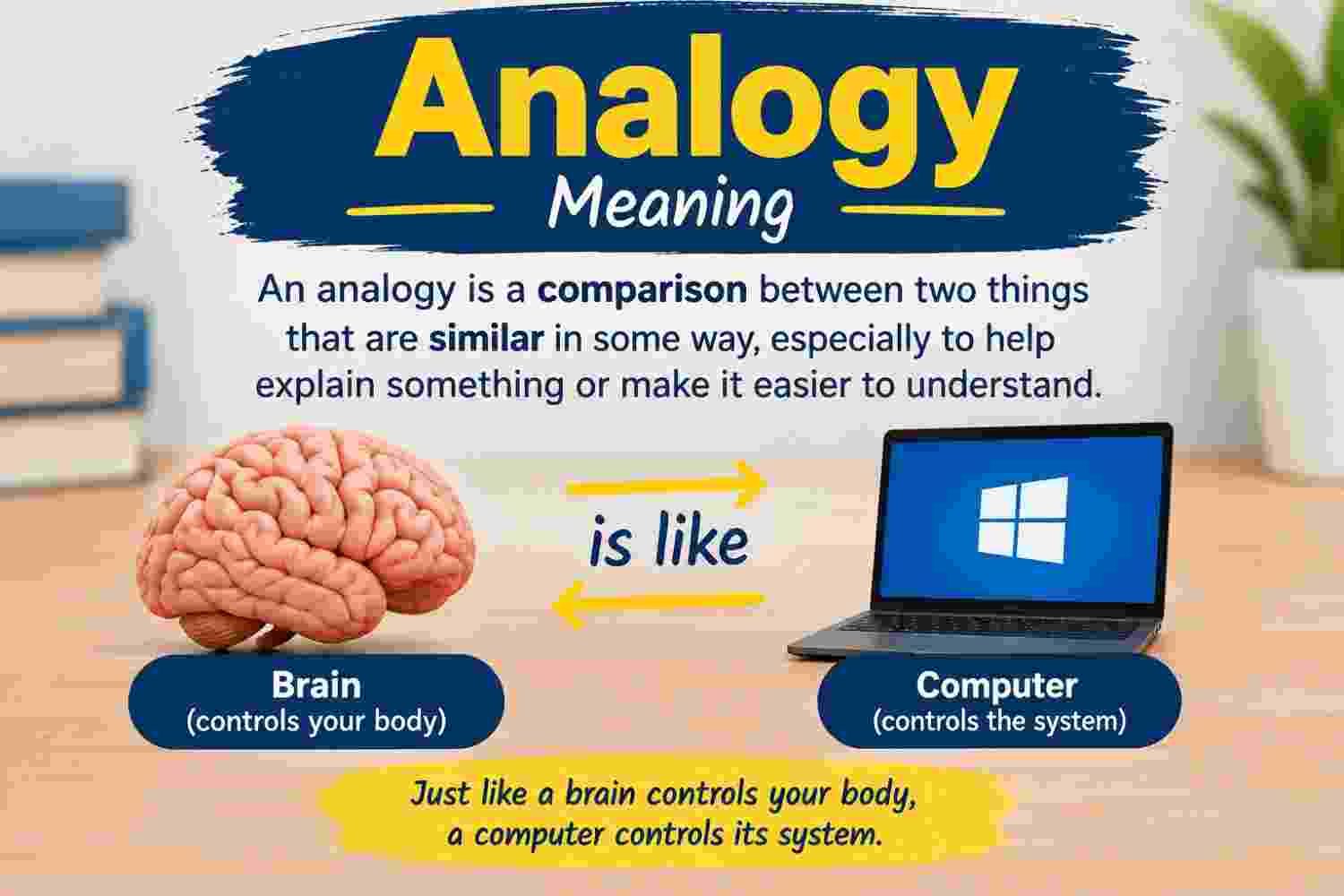
At its heart, an analogy is a comparison between two different things that share a similar pattern or relationship. It’s not saying one thing IS another; it’s saying one thing WORKS LIKE another.
Think of a doctor explaining the heart. Instead of drowning a patient in medical jargon, she says the heart works like a pump pushing water through pipes. Suddenly, a confusing organ becomes something everyone already understands.
The Simple Formula Behind Every Analogy
Every strong analogy follows a hidden structure that you can spot once you know it. It usually sounds like “A is to B as C is to D.”
Here’s how that formula plays out in real life:
- Just like a foot is a sock, a hand is a glove.
- Bird is to sky as fish is to water
- Teacher is to student as coach is to athlete
Notice how each pair shares a relationship, not just a similar object. That relationship is the entire secret behind why analogies work so well.
Analogy vs Metaphor vs Simile: Why People Mix Them Up
This is where most students trip up, and honestly, most adults too. The three terms feel like cousins, but they behave very differently in a sentence.
A simile uses “like” or “as” to compare two things directly. A metaphor skips the comparison words and just claims one thing IS another. An analogy goes deeper, explaining a relationship between two pairs of ideas to teach or clarify something.
| Term | Definition | Example |
|---|---|---|
| Simile | Compares using “like” or “as” | Her smile was like sunshine |
| Metaphor | States one thing is another | Her smile is sunshine |
| Analogy | Compares relationships between pairs | Her smile is to a room as sunshine is to a garden |
Looking at this table, you can see the analogy does more work. It doesn’t just decorate a sentence; it builds a bridge between something unfamiliar and something the reader already gets.
Why Analogies Are So Powerful In Everyday Communication
Our brains are wired to understand new information by connecting it to old information. That’s exactly why analogies feel so satisfying when we hear a good one.
They Make Complicated Ideas Feel Simple
Think about how often teachers use analogies in science class. Explaining that electricity flows like water through a pipe helps students grasp voltage, current, and resistance without a single equation.
Without that bridge, abstract concepts stay abstract forever. Analogies act like a translator between expert knowledge and everyday understanding.
They Make Writing And Speeches Memorable
Politicians, authors, and public speakers use analogies because plain facts rarely stick in memory. A well-placed comparison, though, often gets quoted for years afterward.
- Steve Jobs once compared computers to “bicycles for the mind”
- Warren Buffett often compares investing to planting trees
- Teachers compare essay structure to building a house, foundation first
Each of these examples proves one thing clearly. A strong analogy sticks in a listener’s brain long after the actual facts get forgotten.
Types Of Analogies You’ll Actually Encounter
Not every analogy looks the same, and knowing the different types helps you spot them faster. Standardized tests especially love throwing these categories at students.
Part-to-Whole Analogies
These compare a piece of something to its complete form. A classic example is “page is to book as brick is to wall.”
Cause-and-Effect Analogies
These connect an action to its natural result. “Fire is to smoke as rain is to flood” fits this pattern perfectly.
Function-Based Analogies
These focus on what something does rather than what it looks like. “Key is to lock as password is to account” shows this relationship clearly.
Degree Analogies
These show intensity differences between similar ideas. “Warm is to hot as cool is to cold” demonstrates this pattern well.
How To Write A Killer Analogy Yourself
Creating your own analogy feels intimidating at first, but it gets easier once you follow a simple process. Great writers don’t just get lucky; they follow a method.
Here’s a step-by-step approach anyone can copy:
- Identify the confusing concept you need to explain clearly
- Find something familiar that shares a similar structure or function
- Test the relationship by checking if both pairs match logically
- Simplify the language so a twelve-year-old could understand it
- Read it out loud to check if it actually flows naturally
Skipping any of these steps usually creates a weak or confusing analogy. The magic happens specifically in step three, where most amateur writers rush past checking the logic.
Common Mistakes People Make With Analogies
Even skilled writers stumble here more often than you’d expect. Watch out for these frequent traps that weaken an otherwise good comparison.
- Forcing unrelated comparisons just because they sound clever
- Overcomplicating the second half of the comparison unnecessarily
- Mixing metaphor and analogy without realizing the difference
- Using outdated references that younger readers won’t recognize
- Stretching the analogy too far, breaking its original logic
A rushed analogy often confuses readers more than plain explanation would. Slowing down during the creation process avoids almost every mistake on this list.
Real Statistics On How Analogies Impact Learning
Cognitive science actually backs up why teachers lean on analogies so heavily. Research consistently shows comparison-based teaching improves retention rates significantly.
| Learning Method | Average Retention After 1 Week |
|---|---|
| Plain lecture only | 20% |
| Lecture with visuals | 35% |
| Lecture with analogies | 55% |
| Analogy plus hands-on practice | 70% |
These numbers tell a clear story about how our brains prefer connection over memorization. Adding even one solid analogy to a lesson plan can nearly triple how much information sticks around later.
Frequently Asked Questions About Analogy Meaning
What is the simplest definition of an analogy?
An analogy is a comparison showing how two different pairs of things share a similar relationship. It helps explain something unfamiliar by linking it to something the reader already understands.
Is an analogy the same thing as a metaphor?
No, they’re related but not identical. A metaphor directly states one thing is another, while an analogy compares the relationship between two separate pairs of ideas.
Can you give a quick real-life example of an analogy?
Sure, here’s a simple one: “Life is to struggle as ocean is to waves.” Both pairs share the same underlying relationship of constant, natural challenge.
Why do teachers use analogies so often in classrooms?
Analogies connect unfamiliar academic concepts to everyday experiences students already understand. This connection speeds up comprehension and dramatically boosts long-term memory retention.
Are analogies used in professional writing and business too?
Absolutely, they show up constantly in marketing, speeches, and pitch decks. Business leaders use analogies to explain complex strategies in ways that clients and investors instantly grasp.
What makes an analogy weak or ineffective?
A weak analogy usually compares things that don’t share a logical relationship at all. It confuses readers instead of clarifying the original point, often because the writer forced the comparison.
How can I get better at creating my own analogies?
Practice by picking a confusing topic and brainstorming three familiar things that behave similarly. Read your attempts out loud and cut anything that feels forced or overly complicated.
Final Thoughts: The Real Secret Behind Analogy Meaning
Analogies aren’t just a literary decoration sitting in old textbooks. They’re a genuine thinking tool that helps humans understand new, scary, or complicated ideas by connecting them to something familiar.
Next time you’re stuck explaining a tricky concept, skip the jargon and reach for a comparison instead. Your reader, listener, or student will thank you for making the invisible suddenly visible.