
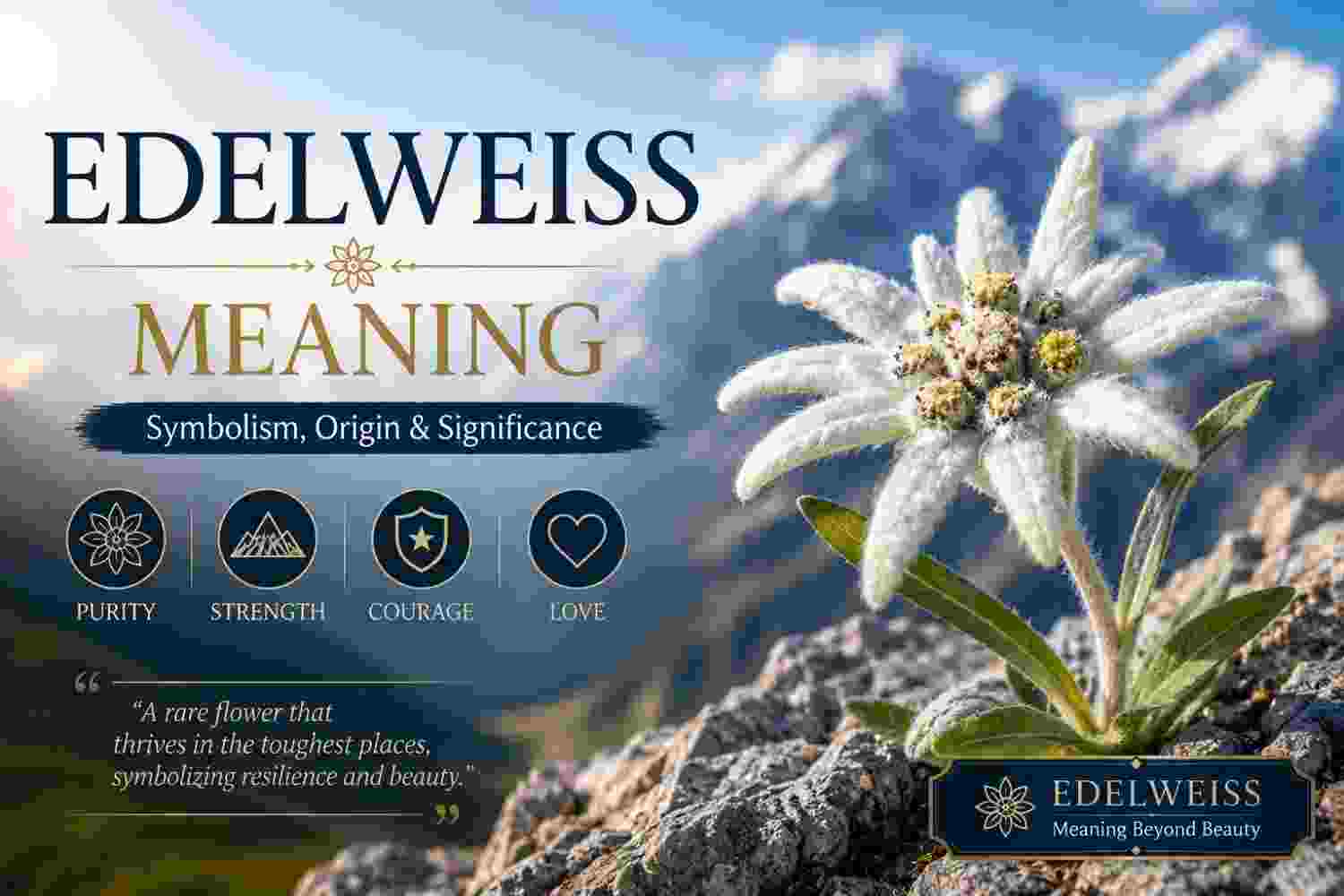
Imagine risking your life on the edge of a limestone cliff, thousands of feet in the air, just to pick a single flower. That is exactly what young men used to do. The edelweiss meaning is far more intense than just a pretty bloom you see on a travel brochure.
Most people assume it is simply the national flower of Austria or a song from The Sound of Music. They are wrong.
In the next few minutes, you are going to discover why this fuzzy, star-shaped plant drove people to madness, how it became a badge of political defiance, and what it truly symbolizes for the modern traveler. You might never look at a souvenir keychain the same way again.
The Real Origin of the Word “Edelweiss”
Before we get into the legends, we have to look at the name itself. The term is pure German, and it is brutally honest about what the plant represents.
It breaks down into two parts: edel meaning noble, and weiss meaning white. That seems simple enough. But the name carries a weight that goes beyond color.
It implies a sense of purity that is almost untouchable. In the high alpine regions, where the air is thin and the landscape is hostile, anything that survives is considered elite. The name wasn’t just a description; it was a title of respect. It signified that this plant belonged to a higher class of nature, far removed from the common daisies in the valley below.
Why “Noble” Matters in the Alps
The concept of nobility in the mountains is tied directly to survival. The flower doesn’t grow in comfortable, easy-to-reach gardens. It thrives in limestone rock and sparse soil.
To the mountain folk, this resilience was a moral lesson. It taught that true beauty and honor come from enduring hardship. The “noble white” was a symbol of endurance against the harshest elements on Earth.
The Harsh Botanical Reality Behind the Legend
It is impossible to understand the edelweiss meaning without understanding where it lives. This isn’t a delicate hothouse flower. It is a biological tank.
Scientifically known as Leontopodium nivale, the plant has adapted to survive ultraviolet radiation, freezing temperatures, and hurricane-force winds. The white “petals” you see are actually not petals at all. They are modified leaves called bracts.
These bracts are covered in tiny, woolly hairs. This fuzz acts as a natural sunscreen, trapping moisture and protecting the plant from the burning high-altitude sun.
The “Fuzz” is a Survival Mechanism
That soft, velvety texture people love to touch is actually a shield. It insulates the plant against the cold and prevents water loss.
This physical toughness is what created the mythology. People looked at this strange, hairy star clinging to a rock and thought it possessed magical properties. It looked alien, yet beautiful. That contrast between the soft appearance and the brutal environment is where the romance began.
The Dark History: The “Flower of Death” and Proving Love
Here is where the story takes a tragic turn. In the 19th and early 20th centuries, the edelweiss became a status symbol for the wealthy tourists of Europe.
But it was also a test for young men. If you loved a woman, you had to prove it. You had to climb into the high crags to pick one for her.
This led to a terrifying spike in fatalities. Men would fall to their deaths, clutching a flower in their hands, trying to prove their devotion. The plant became known as the Flos Reginae or the “Queen of the Flowers,” but also as a grim marker of risk.
Why Risk Your Life?
The logic was simple: if a man was willing to die to retrieve a rare item for his beloved, his love was authentic. It was a courtship ritual built on high stakes.
This dangerous practice actually forced the government to step in. In the late 1800s, the flower was placed under protection in many regions. It became illegal to pick it, which only increased its allure to rebels and lovers alike.
Symbolism Through the Ages: What the Edelweiss Represents
The edelweiss meaning has shifted dramatically over the decades. It is a chameleon of symbolism.
For some, it means adventure and rugged mountaineering. For others, it represents deep, unbreakable love. Let’s break down the four main pillars of its symbolic weight.
1. The Ultimate Badge of Honor
In the military, specifically among the German Alpine troops and Austrian forces, the edelweiss was the highest mark of a mountain soldier. It wasn’t just issued; it was earned.
Soldiers would train for months to earn the right to sew the metal pin onto their caps. It signified that you were an elite warrior, capable of navigating terrain where ordinary soldiers would perish.
2. A Token of Memory and Loyalty
Because the flower is preserved easily (it dries out and retains its shape), it became a keepsake. Soldiers carried it into war to remind them of home.
If you gave someone an edelweiss, you were promising to return. It was a physical anchor to a place of peace when surrounded by chaos.
3. Political Defiance
You have to address the elephant in the room. In the 1930s, the flower was co-opted by certain political factions, most notably the Nazi party, who used it on some badges.
However, paradoxically, it was also used by the anti-Nazi youth movements, like the Edelweiss Pirates. These were young Germans who resisted the Hitler Youth. They pinned the flower to their collars as a symbol of rebellion against conformity. This dual use makes the flower a complex symbol of both oppression and freedom.
4. The Promise of the “Last Frontier”
Today, the flower represents the pristine wilderness. It stands for the last places on Earth that remain untouched by the modern world. It is the spirit of exploration.
When you see it on a brand or a product, the marketing message is: “This is tough, this is pure, and this is rare.”
The Military Connection: From Elite Troops to Anti-Nazi Rebels
Let’s dig deeper into the military aspect because it is the most misunderstood part of the edelweiss story.
During World War I, the German and Austro-Hungarian armies fought brutal battles in the Dolomites and the Alps. The soldiers who fought there were often mountaineers and climbers. They adopted the flower as their unit insignia.
It wasn’t a political statement at first; it was a functional identifier. If you saw a man with an edelweiss badge, you knew he could climb, shoot, and survive in the snow.
The Edelweiss Pirates
This is the plot twist of history. In the late 1930s, groups of working-class teenagers in Germany began to reject the strict militarism of the Hitler Youth.
They wanted to hike, sing banned songs, and fight the patrols. They called themselves the Edelweiss Pirates (Edelweißpiraten).
They used the flower as a symbol of their refusal to be controlled. It was dangerous. Many were caught and executed. Their story proves that the meaning of this flower is not static; it belongs to whoever dares to claim it.
Modern Uses and Conservation Status
So, where does that leave us today? If you see an edelweiss in a store, it is almost certainly cultivated, not picked from the wild.
Strict laws protect the wild populations. Picking a wild edelweiss in countries like Austria, Germany, and Switzerland can result in massive fines.
Farmers have learned to grow the flower in lower altitudes, though it loses some of its “fuzz” when grown in oxygen-rich environments. The plant is not globally endangered, but it is strictly monitored.
Where to Find It Today
- Cultivated Farms: Switzerland and Austria have farms dedicated solely to growing edelweiss for cosmetics and souvenirs.
- High Altitude Trails: You can still see them in the wild if you hike above 2,000 meters in the Pyrenees or the Alps.
- Botanical Gardens: Many alpine gardens showcase them safely for tourists.
A Quick Breakdown of Symbolic Associations
To make this easy to digest, here is a table analyzing the different contexts of the edelweiss meaning:
| Context | Symbolic Meaning | Emotional Trigger |
|---|---|---|
| Romance | Dangerous love, ultimate sacrifice | Passion, Devotion |
| Military | Elite status, alpine skill | Respect, Authority |
| Resistance | Rebellion, freedom, youth | Defiance, Courage |
| Tourism | Adventure, pristine nature | Nostalgia, Wanderlust |
| Medicine | Healing, durability | Comfort, Trust |
This table highlights why the flower is so versatile. It is a mirror. You see in it what you value most: love, strength, or freedom.
The Chemistry of the Flower (Why It Heals)
Beyond the symbolism, the edelweiss has a very real chemical benefit. This is why the cosmetics industry has gone crazy over it.
The plant produces high levels of antioxidants, specifically leontopodic acid and chlorogenic acid. These compounds are incredibly effective at fighting free radicals.
It also contains compounds that are proven to inhibit the breakdown of hyaluronic acid in the skin. In plain English: it helps your skin retain moisture and elasticity.
Is it Safe?
Yes, edelweiss extract is widely considered safe for topical use. It is non-toxic and rarely causes allergic reactions. It has been used in traditional folk medicine for centuries to treat abdominal pain and respiratory issues.
Modern science is only now catching up to what mountain healers knew long ago: this plant is a chemical powerhouse built to withstand stress.
Frequently Asked Questions
What does the name Edelweiss literally mean?
The name is German and translates directly to “noble white.” It is a compound of the words edel (noble) and weiss (white). The name refers to the flower’s pristine white color and its association with the high, “noble” peaks of the Alps.
Is the Edelweiss flower poisonous?
No. Despite the “dangerous” reputation it gained from people falling off cliffs to pick it, the flower itself is not toxic. In fact, it is edible and used in teas and cosmetics. The danger comes from the terrain it grows in, not the plant biology.
Can you legally pick Edelweiss?
In most Alpine regions, it is strictly forbidden to pick wild edelweiss. It is a protected species in Austria, Switzerland, France, and Italy. If you are caught picking one in the wild, you can face heavy fines. Always buy cultivated varieties from local farms.
Why did soldiers wear the Edelweiss badge?
Soldiers wore the edelweiss badge to signify that they were mountain troops. It proved they had survived the rigorous training required to fight in alpine conditions. It was a mark of honor, physical endurance, and elite status within the military.
Is Edelweiss only found in Austria?
While Austria loves it and features it on the 2-cent Euro coin, it is not exclusive to Austria. It grows across the greater Alpine belt, including Switzerland, Germany, Italy, and France, as well as in the Pyrenees and the Carpathian Mountains.
What does an Edelweiss tattoo symbolize?
An edelweiss tattoo usually symbolizes a connection to mountaineering, a dedication to a difficult journey, or a vow of loyalty. Because of its use by the Edelweiss Pirates, it can also represent anti-authoritarianism and fighting for personal freedom.
Does Edelweiss smell good?
The scent is often described as sweet and slightly spicy, similar to honey and hay. However, the wild flower has a very subtle scent. The extracts used in perfumes are often amplified to capture that “alpine freshness.”
The Final Verdict: Why We Still Care
We are still drawn to the edelweiss because it is a symbol of things we lack. We live in a world of mass production and instant gratification.
The edelweiss represents the opposite. It represents scarcity, patience, and the beauty of something that cannot be easily bought. It forces us to respect nature, not just consume it.
The next time you see this little white star on a bottle of lotion or a hiking hat, remember the men who died on the cliffs for it. Remember the teenagers who rebelled against a regime with it pinned to their shirt.