
You scrolled past a meme, saw someone comment “bro got kayo’d ,” and had no clue what just happened. One tiny word, three wildly different meanings, and a whole lot of confusion.
The kayo meaning most people chase online comes straight from boxing slang for “knockout,” but that’s only part of the story. This little word has been trending across TikTok roasts, gaming chats, and bilingual comment sections all at once — which is exactly why your search history brought you here.
Right now it’s spiking because meme accounts and fighting-game streamers keep dropping it in captions, while millions of Filipino speakers use the same spelling to simply say “you.” Same four letters, totally different vibes. Let’s clear it all up.
Quick Info: Kayo at a Glance
| Detail | Snapshot |
|---|---|
| Primary Slang Use | Phonetic spelling of “K.O.” (knockout) |
| Origin | Boxing vernacular, dated to 1923 |
| Pronunciation | “KAY-oh” (English) / “ka-YO” (Tagalog) |
| Alternate Meaning | “You” (plural/respectful) in Filipino/Tagalog |
| Popularity Driver | Gaming clips, meme captions, roast culture |
| Related Terms | KO, TKO, knockout, wrecked, owned |
| Vibe | Playful, cheeky, casual — not for formal use |
Section A: The Real Story Behind the Kayo Meaning
Here’s the fun part. The kayo meaning you see in memes isn’t new at all — it’s over a hundred years old.
The word “kayo” is simply the spelled-out, phonetic version of “K.O.,” the boxing shorthand for knockout. Etymology records trace this exact spelling back to 1923. 1
“Knockout” itself is even older, showing up in fighting circles around 1882 as shorthand for “to knock out of time.” 1 So when a boxer landed a punch that dropped their opponent for the ten-count, commentators called it a K.O. — and eventually people just started writing it the way they said it.
That’s the whole trick behind the kayo meaning. Say “K.O.” out loud. You get “kay-oh.” Write that down casually and you land on “kayo.” Simple as that.
From the Boxing Ring to Your Group Chat
For decades, this word lived mostly inside sports coverage. Dictionaries still list it cleanly as both a noun and a verb — “a blow that renders the opponent unconscious,” and “to knock unconscious or senseless.”
Then the internet got hold of it. The modern kayo meaning stretched way past the boxing ring. Now it describes any moment where someone or something gets absolutely demolished — a bad fantasy football week, a savage comeback, a one-sided video game match.
Lose a match badly? “I got kayoed.” Wrecked after a brutal workout? “”I am kayoed.” A flawless roast is dropped by someone? “She totally kayoed him.” It’s the same knockout energy, just applied to everyday chaos.
The Filipino Plot Twist Nobody Expects
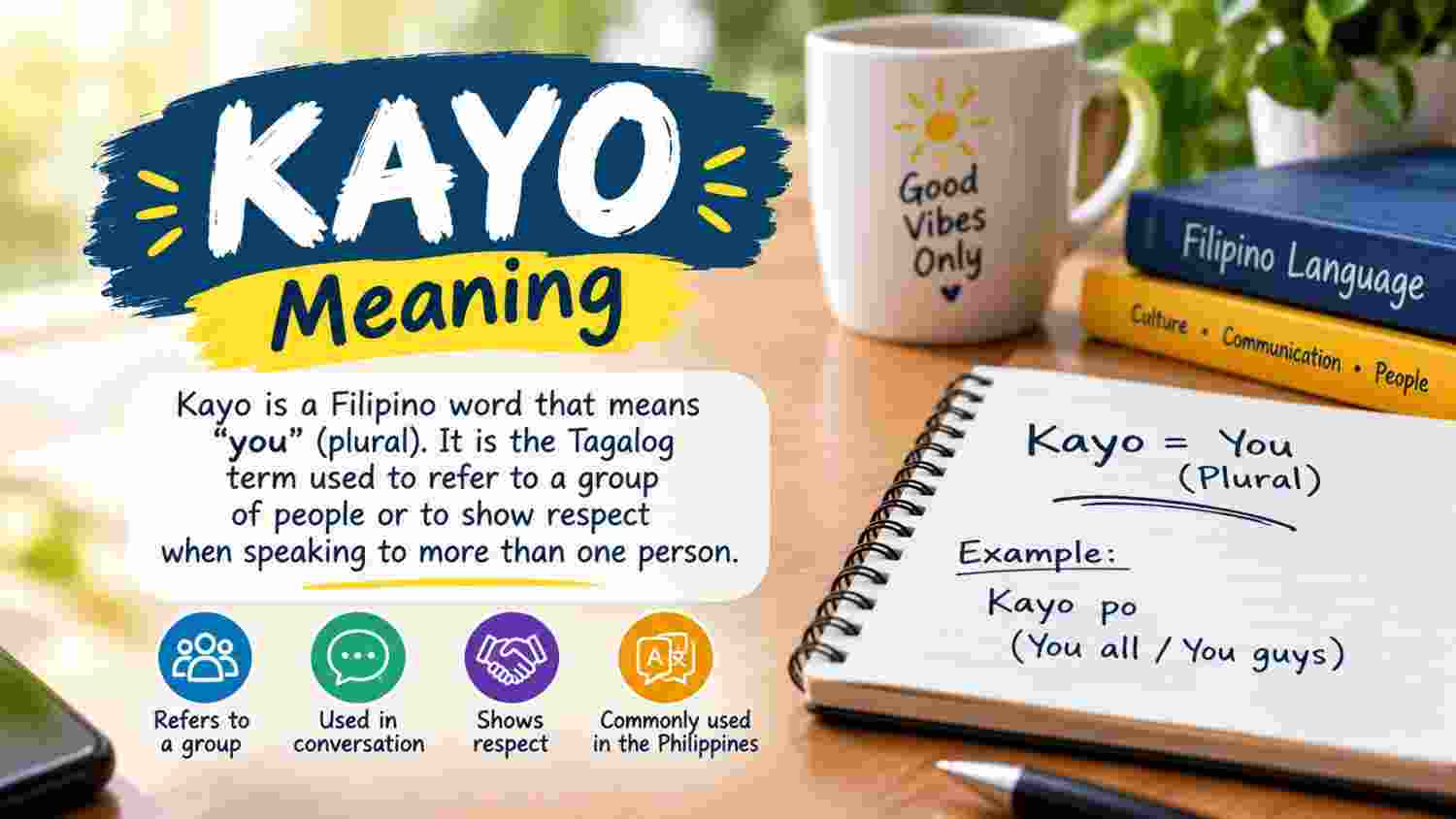
Now for the curveball that trips up a huge chunk of searchers. In Filipino (Tagalog), “kayo” is a completely different word with zero connection to boxing.
There, the kayo meaning is the second-person pronoun for “you” — used when addressing multiple people, or one person respectfully. 4 Think “Kamusta na kayo?” meaning “How are you all?”
This matters enormously online, because Filipino is one of the most active languages on social platforms. So when you spot “kayo” in a comment thread, context is everything. A gaming roast points to knockout. A warm bilingual caption points to “you.” Same spelling, opposite worlds.
Tagalog also builds a neat little family of pronouns around it, which is worth knowing if you want the full kayo meaning. “Ikaw” is the informal singular “you,” “kayo” is the plural or respectful “you,” “tayo” means “we” including the listener, and “kami” means “we” excluding them.
That system is why native speakers rarely mix them up — each word signals exactly who’s being addressed. English lumps all of that into one flat “you,” so the layered kayo meaning genuinely surprises learners who stumble onto it.
A Quick Note on Pronunciation
Pronunciation is the fastest way to tell the two apart out loud. The boxing kayo meaning is said “KAY-oh,” stressing that first syllable like the letters K and O. 2
The Filipino version lands differently, closer to “ka-YO,” with a softer, quicker rhythm. Hear someone say it and the emphasis usually gives away which meaning they’re reaching for before the sentence even finishes.
Section B: How to Use Kayo the Right Way (Step-by-Step)
Ready to drop this word without embarrassing yourself? Follow these steps and you’ll nail the kayo meaning every single time.
Step 1: Read the room first.
Check the language and the setting. Filipino conversation? It almost certainly means “you.” English meme or gaming chat? It means knockout.
Step 2: Match it to a “defeat” moment.
For the slang kayo meaning, reserve it for a clear loss, fail, or roast. Someone bombed, got owned, or got wiped out. That’s your cue.
Step 3: Pick your form.
Use it as a verb (“you got kayoed”) or a noun (“that was a clean kayo”). Both work in casual talk.
Step 4: Add flavor with emojis.
The knockout kayo meaning thrives with , or attached. It signals you’re joking, not being cruel.
Step 5: Know when to zip it.
Skip it in professional emails, serious conversations, or when someone is genuinely hurt. The playful kayo meaning falls flat — or reads as rude — in those spots.
Real Examples You Can Steal
- After a gaming loss: “Bruh, I got kayoed in one move. No hope.”
- Reacting to a roast: “She kayoed him with that burn .”
- Pure exhaustion: “After that 10-hour meeting? Fully kayoed.”
- Filipino warmth: “Salamat, ingat kayo ” (“Thanks, take care, you all.”)
Notice how the emotional tone comes from the surrounding words, not “kayo” itself. On its own, the word is neutral — punctuation and emojis do the heavy lifting.
Section C: Why the Kayo Meaning Is Everywhere Right Now
So why is this old boxing term suddenly popping off? A few forces collided.
Meme culture supercharged it. Accounts love captioning clips of animals, cartoons, or clumsy fails as getting “kayo’d” — the cat that missed the jump, the dog that slipped. 3 That bite-sized humor travels fast.
Gaming communities did the rest. In fighting games especially, players use the kayo meaning to celebrate a crushing win over an opponent. When streamers say it on camera, their audiences pick it up overnight.
Then there’s the bilingual overlap. Because millions of Filipino users are online daily, the “you” version keeps colliding with the “knockout” version in the same feeds. That clash sparks curiosity — and curiosity sparks searches. It’s a big reason the kayo meaning keeps trending.
What Language Experts Actually Say
Dictionaries and etymology sources are refreshingly consistent here. They agree the slang kayo meaning is a straightforward phonetic reversal of the boxing “K.O.,” in use since the 1920s. 1
Language sites also flag its figurative power. You can “kayo the competition” with a killer business pitch, meaning you decisively end their chances. 1 That flexibility — literal punch to metaphorical mic drop — is why the word refuses to die.
Comparison Table: The Three Faces of Kayo
| Context | What Kayo Means | Example | Tone |
|---|---|---|---|
| Boxing / MMA | A literal knockout that ends the fight | “The champ won by kayo in round two.” | Serious, sporty |
| Internet slang | Getting wrecked, owned, or defeated | “You got kayoed this week “ | Playful, teasing |
| Filipino (Tagalog) | “You” (plural or respectful) | “Kamusta na kayo?” | Warm, neutral |
Keep this table handy. Ninety percent of the confusion around the kayo meaning disappears the moment you match the word to its context.
Frequently Asked Questions
What does kayo mean in text?
In English chats it usually means “knocked out,” “owned,” or “totally defeated,” borrowed from boxing’s “K.O.” In Filipino texts, it simply means “you,” especially when addressing a group.
Is kayo the same as KO?
Yes, the slang kayo meaning is literally the phonetic spelling of “K.O.,” short for knockout. They’re interchangeable, though “kayo” reads more casual and meme-friendly.
What does kayo mean on TikTok?
It depends on the caption’s language. English videos lean on the knockout kayo meaning for roasts and fails, while bilingual clips often keep the Tagalog “you.”
Is it rude to say kayo?
Not usually — it’s meant as light roasting between friends. Just avoid aiming it at someone genuinely upset or dropping it in formal settings.
The Final Word on Kayo
So there it is — one small word carrying a century of boxing history, a fresh coat of meme energy, and an entirely separate life in the Filipino language. Once you clock the context, the kayo meaning stops being confusing and starts being genuinely fun to use.
Whether you’re roasting a friend’s fantasy team, hyping a knockout clip, or warmly greeting a group, you now know exactly which “kayo” you’re reaching for. Use it wisely, add an emoji, and watch it land.
Which version of the kayo meaning did you run into first — the knockout or the Tagalog “you”? Drop your story in the comments.