
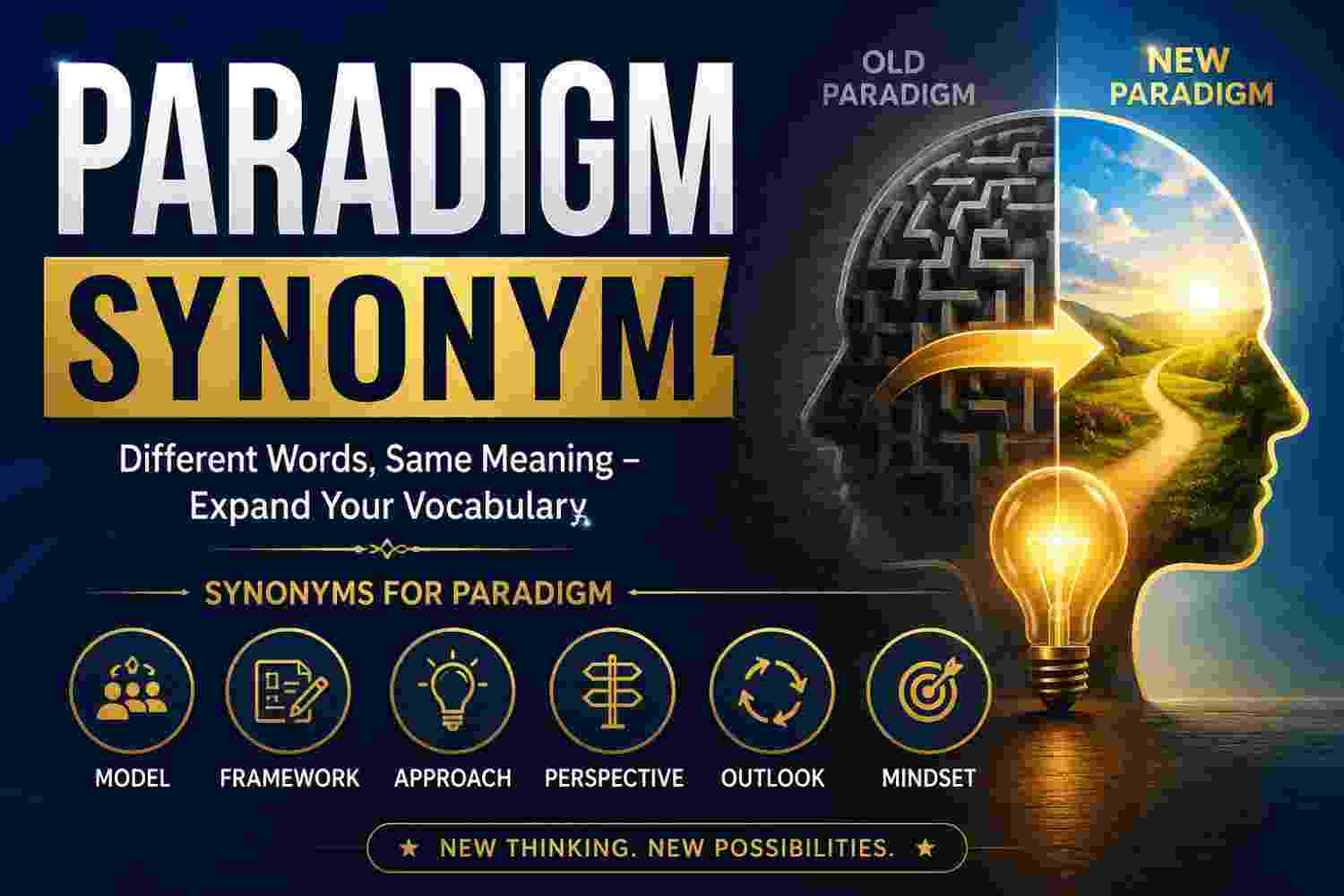
Finding the right paradigm synonym can completely transform how your audience perceives your ideas. Repeating the same technical jargon over and over weakens your writing and bores your audience.
Whether you are drafting a business proposal, a college paper, or a tech blog, choosing the right word matters. This guide gives you the exact alternative terms you need to write with clarity, authority, and impact.
Why Relying on a Single Paradigm Synonym Limits Your Writing
Language shapes how people perceive your expertise. When you reuse heavy corporate terms repeatedly, readers tune out and lose focus.
Switching up your vocabulary keeps your tone fresh and precise. It allows you to match your exact message to the right audience every single time.
Using diverse terminology also strengthens your content strategy. It brings natural LSI keywords into your work, which helps search engines understand your context faster.
10 Powerful Paradigm Synonym Options for Business and Tech
Not every alternative word fits every single sentence. You need to pick the exact match based on the context of your discussion.
Below is a curated selection of alternative terms, complete with real-world applications and professional usage contexts.
1. Framework
A framework refers to a supporting structure or an underlying system. It works best when you are describing a step-by-step process or a technical architecture.
- Best Used In: Software engineering, corporate strategy, project management.
- Example: “Our team built a brand-new operational framework to handle client onboarding smoothly.”
2. Model
Use model when you are presenting an ideal representation or an abstract copy of a real system. It helps turn complex theories into visual or actionable formats.
- Best Used In: Data science, economics, product design.
- Example: “The company shifted its revenue model to subscription-based pricing this quarter.”
3. Archetype
An archetype is a perfect, classic example of a specific pattern or personality. It carries a stronger, more creative weight than standard business words.
- Best Used In: Branding, marketing, literature, psychology.
- Example: “Apple remains the classic archetype of minimalist hardware design in tech.”
4. System
A system describes a set of principles or procedures according to which something is done. It focuses on the inner mechanics and moving parts of an idea.
- Best Used In: Logistics, IT infrastructure, organizational design.
- Example: “The new management system cut internal review times in half.”
5. Benchmark
A benchmark serves as a standard or point of reference against which things may be compared. It is ideal when discussing performance and quality standards.
- Best Used In: Quality assurance, competitive analysis, finance.
- Example: “This software set a new benchmark for speed in cloud processing.”
6. Prototype
A prototype is an early sample, model, or release of a product built to test a concept. It implies experimentation and active development.
- Best Used In: Manufacturing, UX design, startup pitches.
- Example: “Engineers tested the prototype to catch bugs before the public rollout.”
7. Exemplar
An exemplar is a person or thing serving as a typical example or appropriate model. It adds an authoritative, academic touch to your sentences.
- Best Used In: Academic papers, executive summaries, thought leadership.
- Example: “She stands as an exemplar of ethical leadership in modern finance.”
8. Pattern
A pattern describes a repeated decorative design, sequence, or recurring series of events. Use it when pointing out trends or user behaviors.
- Best Used In: User research, analytics, behavioral psychology.
- Example: “Data shows a clear pattern of shifting consumer preferences toward mobile video.”
9. Blueprint
A blueprint is a detailed plan or technical drawing that guides future execution. It gives readers a concrete, visual image of structure.
- Best Used In: Architecture, strategic planning, product roadmaps.
- Example: “The founder shared her blueprint for scaling the agency across Europe.”
10. Matrix
A matrix is an environment or structure in which something develops or takes form. It highlights interconnected elements working together.
- Best Used In: Operations research, risk management, organizational theory.
- Example: “We mapped our risk evaluation across a two-dimensional decision matrix.”
Comparing the Top Vocabulary Alternatives
Selecting the right term depends heavily on tone, target audience, and formal requirements. The grid below breaks down how these choices perform across different industries.
| Vocabulary Option | Formality Level | Primary Industry | Best Use Case |
| Framework | High | Business & Tech | Outlining strategic processes |
| Model | Medium-High | Data & Finance | Visualizing abstract concepts |
| Archetype | High | Marketing & Design | Defining brand personalities |
| System | Medium | IT & Operations | Explaining workflow mechanics |
| Blueprint | Medium | Construction & Strategy | Mapping future growth steps |
Each word alters the subtle tone of your sentence. Choosing “blueprint” makes your plan sound practical, while “archetype” makes your brand feel legendary.
Matching these subtle differences prevents miscommunication and makes your writing sound natural to industry insiders.
How to Execute a Terminology Shift in Business Writing
Shifting terminology inside an organization requires more than just swapping out words in a document. It reflects a fundamental pivot in how your team thinks and operates.
When leadership announces a major strategic pivot, using clear language prevents panic and confusion.
To execute a smooth transition, start by identifying structural bottlenecks in your current message. Map out clear steps so every department understands the new direction.
Finally, train your teams on the new terminology. Consistent communication ensures that everyone works toward the exact same goals.
Common Mistakes to Avoid When Choosing Alternative Words
The biggest mistake writers make is treating every single entry in a thesaurus as a direct replacement. Context always rules over simple definition matching.
For example, substituting “archetype” into a purely technical database explanation usually sounds awkward and out of place.
Another common trap is stacking complex buzzwords together in a single sentence. Heavy word stacking confuses readers and hides your true message.
Always prioritize clarity over sounding overly sophisticated. Clear, simple language wins trust far faster than pretentious vocabulary.
Frequently Asked Questions
What is the most common paradigm synonym in business?
The word “framework” is the most popular substitute in corporate settings. It clearly describes operational processes without sounding academic or overly theoretical.
Can I use “model” and “paradigm” interchangeably?
Yes, in most general contexts they overlap significantly. However, “model” usually refers to a specific system, while “paradigm” describes a broader worldview or mindset.
How do I pick the right word for academic papers?
Academic writing favors precise terms like “exemplar,” “archetype,” or “matrix.” Match your term directly to whether you are discussing a theory, a sample, or a pattern.
Why does word choice matter for SEO content?
Search engines analyze semantic relationships between words to understand your topic. Using accurate, varied terms helps your content rank naturally for semantic search queries.
Which word works best for software development?
Software engineers prefer “framework,” “system,” or “pattern.” These terms accurately describe code architecture, system design, and recurring development solutions.
Is “shift” considered an alternative word?
“Shift” is usually combined with these terms (as in a “concept shift”). It describes the movement or change from one established system to another.
Master Your Vocabulary for Clearer Communication
Upgrading your vocabulary is one of the fastest ways to build authority in your writing. Replacing repetitive jargon keeps your content sharp, engaging, and professional.
Take time to match your word choice to your specific audience and goal. With these alternatives in your toolkit, you can write cleaner, more compelling content every single time.
To take your writing further, audit your recent reports or articles. Swap out overused phrases with precise alternatives and watch your clarity instantly improve.