
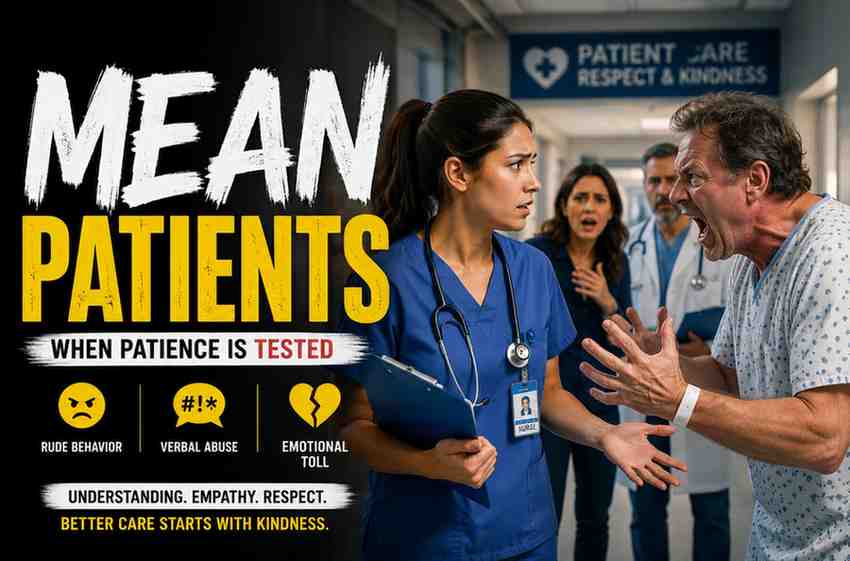
A patient screams at you before you finish the morning greeting. Your hands shake, your stomach knots, and the shift just started. Mean patients don’t simply hurt feelings—they chip away at clinical judgment, staff morale, and personal safety. This guide gives you clear, field-tested methods to defuse hostility, draw firm lines, and guard your mental health while delivering the care every person deserves.
Understanding Why Patients Become Mean
Pain rewires patience. A person who feels cornered by illness, fear, or loss of independence often fires hostility as a shield. The Joint Commission identifies untreated pain, psychiatric conditions, dementia, substance withdrawal, and previous trauma as common triggers for patient aggression. Recognizing these roots doesn’t excuse abuse. It arms you with context, making your response quicker and more strategic.
The Hidden Toll Mean Patients Take on Healthcare Teams
Repeated exposure to verbal abuse fuels burnout, compassion fatigue, and clinical errors. A 2022 study in the Journal of Emergency Nursing found that nurses who faced frequent patient hostility reported a 40% higher emotional exhaustion score. When mean patients drain your empathy reserve, everyone loses—other patients, your colleagues, and you. Naming the cost is the first step toward fixing it.
Early Warning Signs You Should Never Ignore
Watch for clenched fists, rapid pacing, a raised voice, or fixed staring. A patient who suddenly stops talking or begins making threats has moved from agitation to crisis. Train your team to flag these red flags during handoffs. Early recognition buys seconds that can prevent a physical confrontation with mean patients.
Verbal De-Escalation Techniques That Actually Work
Speak low and slow. Use the person’s name. Say, “I hear that you’re frustrated, and I want to help.” Avoid crossing your arms or standing over the patient. Offer two small choices—“Would you like water first or a blanket?”—to restore a sense of control. These simple moves halt escalation better than logic or lectures. When mean patients feel heard, the temperature drops fast.
Setting Boundaries Without Sounding Cold
Clear limits protect both parties. “I want to listen, but I can not do that when you yell at me,” you can say.Let’s take a breath and start again.” Repeat this calmly until the message lands. Boundaries aren’t walls; they are a promise of respect. Mean patients often test limits because previous caregivers let them, so consistency rewrites the script.
How to Stay Grounded When a Patient Attacks Your Character
Detach the insult from your identity. Tell yourself, “This isn’t about me. This is their pain talking.” Use box breathing—inhale four counts, hold four, exhale four—between responses. Once the encounter ends, write one factual sentence in a notebook to release the sting. Self-regulation stops mean patients from planting seeds of self-doubt that grow into burnout.
Safety Protocols That Belong in Every Facility
Every room should have an unobstructed exit path. Panic buttons, security escorts, and a zero-tolerance flagging system in the electronic health record are non-negotiable. The Occupational Safety and Health Administration mandates that employers provide a workplace free from recognized hazards, which includes violence from mean patients. Review your facility’s crisis plan monthly; complacency invites injury.
Documenting an Encounter the Right Way
Write what you observed, not what you felt. Quote exact words when possible. Note the time, location, witnesses, and any triggering event. Avoid phrases like “the patient was rude.” Instead, record, “Patient stated, ‘You’re all incompetent,’ and pounded the bed rail.” Strong documentation creates a legal shield and a behavior pattern that justifies future safety measures with mean patients.
Supporting a Colleague After a Brutal Shift
Pull them aside privately. Ask, “Do you want to talk or just sit for a minute?” Validate their reaction without comparing war stories. A simple “That was hard, and you handled it well” rebuilds confidence faster than advice. Peer support reduces the emotional hangover that mean patients can leave behind and strengthens the team’s armor.
Self-Care Practices That Recharge Emotional Batteries
Walk outside for ten minutes before driving home. Keep a gratitude note on your phone with three good moments from the day. Schedule quarterly check-ins with a counselor who understands healthcare trauma. Protecting your mind isn’t optional; mean patients don’t get the final word on your worth. Treat your recovery as seriously as you treat a patient’s wound.
Training Your Team to Defuse Hostility Fast
Role-play real scenarios during staff meetings. Practice the “broken record” technique: repeat your boundary phrase up to three times without changing your tone. Invite a behavioral health specialist to teach trauma-informed communication. Teams that drill together respond faster and fumble less when mean patients erupt unexpectedly.
When to Call Security or Law Enforcement
Imminent threat means you act immediately. A weapon, physical lunging, or a direct threat to kill removes every other option. Hit the panic button, clear the area, and do not negotiate alone. It is dangerous to wait for things to “cool down.”Mean patients who cross into physical danger zones require an immediate, unified response from trained security personnel.
Navigating the Legal and Ethical Gray Areas
You can set conditions for care but you cannot abandon a patient. The American Medical Association’s Code of Ethics allows termination of the patient-physician relationship only after proper written notice and emergency coverage arrangements, except in cases of imminent danger. Document all steps. Consult your risk management team early. Mean patients still hold rights, and a misstep here can backfire legally.
Building a Culture Where Respect Is the Default
Leaders must model zero-tolerance language, celebrate staff who maintain professionalism under fire, and regularly audit aggression reporting systems. When administrators acknowledge that mean patients impact retention and outcomes, they invest in de-escalation training, adequate staffing, and mental health resources. Culture shifts when the loudest voice in the room says, “We protect our people.”
Common Types of Mean Patients and How to Respond
| Patient Type | Typical Behaviors | Recommended Approach |
| The Chronically Disrespectful | Insults, demeaning remarks, frequent complaints | Maintain professional neutrality, set consistent verbal limits, and involve a supervisor early. |
| The Manipulative | Threats to sue, demands for specific medications, splitting staff | Stick to policy, communicate with one unified voice, and document every request and response. |
| The Aggressive | Shouting, throwing objects, physical intimidation | Prioritize safety, use non-confrontational body language, and summon security without delay. |
| The Anxious Projector | Fear masked as anger, snapping at helpers, refusal of care out of panic | Offer reassurance, explain each step before acting, and give small choices to rebuild trust. |
| The Entitled Bully | Belittling staff, demanding VIP treatment, name-dropping | Acknowledge their concerns briefly, redirect to the care plan, and never reward abusive conduct with special privileges. |
Frequently Asked Questions About Mean Patients
What should I do when a mean patient insults me personally?
Breathe, ignore the insult, and restate your purpose: “I’m here to help you feel better. Let’s focus on that.” Refuse to absorb their words. Debrief with a peer afterward so the moment doesn’t replay in your mind all day.
Can I refuse to treat a patient who is mean?
Only after exhausting all reasonable efforts, documenting thoroughly, and following your organization’s termination-of-care policy. Emergency situations require immediate treatment regardless of behavior. Never walk out without a safe handoff; abandonment charges are serious.
How do I document verbal abuse from mean patients without sounding biased?
Use direct quotes, record observable actions, and note the presence of witnesses. Avoid labels like “crazy” or “nasty.” Clear, behavioral language keeps the record credible and useful for future encounters.
Why do some patients become mean so suddenly?
Acute pain, medication side effects, hypoglycemia, urinary retention, or a brewing infection can trigger rapid behavioral changes. Always rule out a medical cause first, especially in older adults. Treating the underlying condition often dissolves the hostility.
What de-escalation phrase works fastest with mean patients?
“I’m here for you. Tell me what you need most right now.” This phrase acknowledges distress and invites the patient to name a concrete need, shifting focus from emotion to solution.
How can I protect my mental health when mean patients appear daily?
Build a ritual that closes the shift: change out of scrubs, listen to a specific playlist on the drive, and talk to a non-medical friend once a week. Use your employee assistance program for counseling. Protecting yourself is a clinical skill, not a luxury.