
You hear “conundrum” tossed around in meetings and books, yet its exact meaning slips through your fingers. Misusing it can chip away at your credibility. This guide dissects the conundrum meaning, traces its tangled roots, and hands you the tools to wield it correctly in any situation.
What Does Conundrum Mean? A Clear Definition
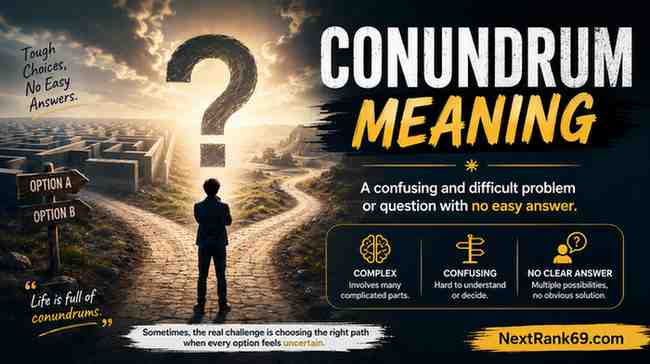
A conundrum describes a confusing or difficult problem that often has no straightforward solution. The word carries a double identity. It can point to a riddle built on a pun or a wordplay twist. It can equally describe a deep ethical dilemma where every option carries a moral cost. Dictionaries define the conundrum meaning as both “a riddle whose answer involves a pun” and “a difficult problem with no clear resolution.” That blend of playful language and serious tension gives the word its staying power.
The Etymology: Where Did the Word Conundrum Come From?
The origin of “conundrum” remains something of a puzzle itself. The Oxford English Dictionary first records it in the late 16th century within academic circles at Oxford University. Scholars used it as a slang term for a pedantic quibble or a fanciful riddle. Its earlier roots stay murky. Some linguists link it to the Latin conandrum, meaning “something to be attempted,” but no evidence seals that connection. This uncertain birth mirrors the conundrum meaning perfectly – a word that arrived as a riddle and never lost its enigmatic core.
Conundrum vs. Riddle vs. Puzzle: Spotting the Differences
Lumping these three together muddies their distinct flavors.
- Riddle: A direct question built on metaphor or double description. It demands a single correct answer. “I speak without a mouth and hear without ears. What am I?” An echo.
- Puzzle: A challenge of logic, pattern recognition, or physical manipulation. Jigsaw puzzles, Sudoku, and crosswords fall here. They test skill and patience.
- Conundrum: This creature lives at the intersection. A classic wordplay conundrum asks, “Why did the chicken cross the road?” with a pun-based punchline. An ethical conundrum, however, offers no punchline at all – just difficult choices.
Understanding the conundrum meaning requires seeing it as a hybrid: part brainteaser, part moral quagmire.
The Two Faces of a Conundrum: Logic and Ethics
A conundrum typically wears one of two masks. The logical conundrum plays with language and expectation. The ethical conundrum probes moral reasoning. Recognizing both unlocks the full conundrum meaning.
Conundrum Types at a Glance
| Type | Core Feature | Classic Example |
|---|---|---|
| Wordplay Conundrum | A riddle whose answer hinges on a pun or a trick of language | “What has keys but no locks, space but no room, and you can enter but not go in?” – A keyboard. |
| Logical Conundrum | A self-referential paradox that challenges formal reasoning | “This statement is false.” If true, it’s a lie; if a lie, it’s true. |
| Ethical Conundrum | A dilemma where every available action violates a moral principle | The Trolley Problem: sacrifice one person to save five, or do nothing and let five die. |
Each type sharpens a different thinking skill. Wordplay conundrums stretch creative language use. Logical ones expose the limits of systems. Ethical ones force you to examine your values.
Famous Conundrums That Shaped History and Philosophy
Some conundrums escaped textbooks and walked into the world. The Trolley Problem, introduced by philosopher Philippa Foot in 1967, remains a staple of ethics courses. It forces a choice between actively harming one person or passively allowing five to die. There is no clean answer, only a hierarchy of values.
The Prisoner’s Dilemma, a game theory conundrum, shows why two rational individuals might not cooperate even when it benefits both. Used during the Cold War, it modeled nuclear stalemate and still shapes negotiation strategies today. These examples prove the conundrum meaning extends far beyond word games; it lives inside real decisions with massive consequences.
Real-Life Conundrums You Face Every Day
Daily life brews its own collection. You receive two job offers. One pays significantly more but swallows your evenings and weekends. The other pays less but leaves space for family and hobbies. No third door exists.
You spot a colleague taking credit for a junior employee’s idea. Speaking up risks office friction. Staying silent betrays your sense of fairness. Everyday conundrums rarely announce themselves with trumpets. They whisper at inconvenient moments, forcing you to weigh competing truths. The conundrum meaning crystallizes in these small, piercing moments.
How to Use “Conundrum” in a Sentence Correctly
Many writers fumble the word by using it as a synonym for any simple problem. A forgotten Wi-Fi password is an annoyance, not a conundrum. Save the term for genuine perplexity or moral weight.
- “The missing evidence presented a legal conundrum the defense team could not crack.”
- “Her offhand joke turned into an ethical conundrum once the video went viral.”
- “Deciding whether to uproot the family for a dream job became a personal conundrum that kept him awake for weeks.”
Place the word where confusion and stakes collide. That usage respects the true conundrum meaning.
Synonyms for Conundrum and When to Use Them
Swapping in a synonym can sharpen your message. But each carries its own shade.
- Dilemma: A choice between two equally unpleasant options. Best for ethical or personal binds.
- Quandary: A state of perplexity or uncertainty about what to do. Emphasizes the confusion, not necessarily the stakes.
- Puzzle: A lighter term for something that tests ingenuity. Downplays moral weight.
- Paradox: A statement that contradicts itself but may hold a deeper truth. Fits logical or philosophical contexts.
- Enigma: A person or thing that is mysterious and difficult to understand. Focuses on obscurity, not a problem to solve.
Choose “dilemma” when the pain of choice dominates. Choose “puzzle” for sheer intellectual challenge. Reach for “conundrum” when you need a word that can shoulder both.
Why Your Brain Loves a Good Conundrum
Cognitive psychology points to a satisfying chain reaction. When you encounter a wordplay conundrum, your brain’s left hemisphere hunts for language patterns while the right hemisphere seeks context. Solving it releases a small burst of dopamine. That flash of pleasure is the same reward system triggered by cracking a joke.
Ethical conundrums activate the brain’s default mode network – the region tied to self-reflection and moral reasoning. A study published in Nature showed that people faced with the Trolley Problem engage both emotional and rational centers. The collision of feeling and logic makes the conundrum meaning so memorable. Your brain sees the tension and refuses to let go until it finds some resolution, even an imperfect one.
Conundrums in Literature and Pop Culture
Writers use conundrums as narrative glue. Shakespeare’s Hamlet revolves around the ultimate ethical conundrum: to act on morally questionable revenge or to suffer in passivity. Hamlet’s “To be, or not to be” soliloquy frames existence itself as an unsolvable riddle.
Modern shows like The Good Place spin entire seasons around moral conundrums. Characters confront the Trolley Problem with actual blood-spattered consequences, making abstract philosophy visceral. The Riddler in Batman comics doesn’t just ask questions; he constructs elaborate wordplay conundrums that test the hero’s mind before his fists. These stories prove that a well-placed conundrum grips audiences tighter than any explosion.
The Art of Crafting Your Own Conundrum
Building a wordplay conundrum starts with a homonym or a double-meaning phrase. Write down a word with two distinct definitions. Build a question that allows both interpretations to coexist until the last word flips the sense. “What invention lets you walk through walls?” The door. The trick hides in plain sight.
For an ethical conundrum, frame a conflict between two deeply held values. Honesty vs. loyalty. Freedom vs. safety. Strip away any easy third option. Test the scenario on a friend. If they hesitate for more than ten seconds, you have built a genuine conundrum. This practice deepens your grasp of the conundrum meaning more than any passive reading can.
Common Mistakes People Make with the Word “Conundrum”
Small missteps drain the word’s power. Avoid these traps.
- Using it for trivial inconveniences. A long coffee queue is not a conundrum.
- Spelling it as “conumdrum” or “conundrem.” The middle syllable is “drum.”
- Treating it as a direct synonym for “mystery.” A whodunit is a mystery; a conundrum carries a specific tension.
- Overusing the plural “conundrums” when the context calls for a singular problem.
Careless handling strips away the precision that makes the conundrum meaning valuable.
Frequently Asked Questions about Conundrum Meaning
What is the simple definition of conundrum?
A conundrum is a confusing and difficult problem or question, often with no clear solution. It can be a riddle built on a pun or a deep ethical dilemma.
Can a conundrum have a correct answer?
A wordplay conundrum typically has one clever answer. An ethical conundrum, however, rarely presents a single correct choice; different moral frameworks lead to different conclusions.
What is the difference between a conundrum and a dilemma?
A dilemma forces a painful choice between two bad options. A conundrum is broader – it can include riddles, paradoxes, and problems where the difficulty lies in understanding the question itself.
How do I pronounce “conundrum” correctly?
It is pronounced kuh-NUN-drum. The second syllable takes the stress, with a short ‘u’ sound as in “fun.”
Where does the word conundrum come from?
Its exact origin is unknown. It first appeared in 16th-century Oxford slang for a quibble or fanciful riddle, possibly linked to Latin roots meaning “something to be attempted.”
Why do people confuse the conundrum meaning with a simple problem?
The word often gets misused as a synonym for any difficulty. Losing the element of paradox or genuine perplexity dilutes the word’s impact and leads to confusion.