
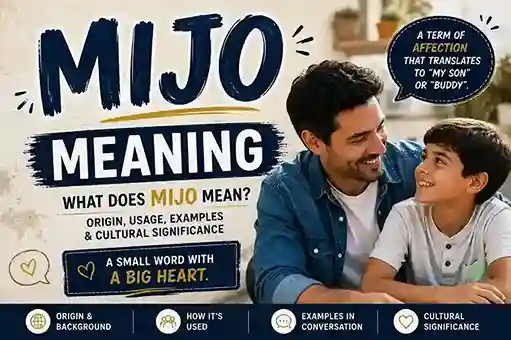
Have you heard the word “mijo” in conversation and sensed a deep fondness, but couldn’t pinpoint what it truly means? That gap can make you feel like an outsider in warm, close-knit exchanges. This guide unpacks the mijo meaning from its roots to modern usage, so you can embrace this beloved term and strengthen your connections.
Mijo Meaning: The Literal Translation
The straight mijo meaning in English is a contraction of “mi hijo,” which translates to “my son.” Yet you rarely use it to refer to a biological child alone. Spanish speakers deploy it as an affectionate nickname for any younger male—or even someone their own age—to convey care, closeness, and familiarity. Think of it as a verbal hug that wraps around the listener.
Its warmth lies in the shortening. Dropping the “h” and the final “o” from “hijo” creates an intimate sound that signals trust. When a neighbor, shopkeeper, or grandmother calls someone “mijo,” they announce, “You matter to me.” That is the heart of the mijo meaning.
Tracing the Origin: Mi Hijo to Mijo
This term didn’t appear in formal textbooks first. It emerged organically in everyday speech. According to the Diccionario de la lengua española (Real Academia Española), colloquial contractions like “mijo” develop when fast, relaxed pronunciation blurs the boundaries between words. Over generations, “mi hijo” softened into “m’ijo” and then into the written form “mijo.”
The mijo meaning grew from its literal root into a social tool. In many Latin American households, parents call their children “mijo” daily, reinforcing emotional bonds. From there, the usage spread to extended family, friends, and even kind strangers. What started as a parent-child phrase became a broad, community-building endearment.
Mijo vs. Mi Hijo: A Contraction That Carries Affection
You might wonder: is “mijo” just a lazy way of saying “mi hijo”? Not exactly. The choice between “mi hijo” and “mijo” carries different emotional weight. “Mi hijo” feels more formal or direct, often used when introducing your son or making a point. “Mijo” glows with tenderness and informality.
Here is a quick comparison:
| Expression | Tone | Typical Context |
|---|---|---|
| Mi hijo | Neutral, sometimes formal | “Este es mi hijo, Carlos.” |
| Mijo | Warm, affectionate, familiar | “Mijo, ¿cómo estás?” |
Understanding this nuance unlocks the full mijo meaning. You aren’t just learning a vocabulary item; you are picking up a relational signal that announces, “We are close.”
When Do Spanish Speakers Use Mijo?
The mijo meaning shines brightest in specific situations. You hear it most often when someone wants to comfort, encourage, or simply acknowledge another person. A parent might say, “Tranquilo, mijo, todo va a estar bien” (Calm down, mijo, everything will be fine). A family friend could greet a young man with, “¡Mijo, cuánto has crecido!” (Mijo, how you’ve grown!).
People also use it to soften a request or instruction. A shopkeeper might hand you change and say, “Aquí tienes, mijo.” The term acts as a social lubricant, reducing distance between speaker and listener. Recognizing these moments helps you grasp the emotional mijo meaning beyond the dictionary.
The Cultural Significance of Mijo Across Latin America
Walking through Mexico, parts of Central America, the Caribbean, and U.S. Latino communities, you quickly notice the mijo meaning woven into daily life. It builds instant rapport. In Mexican culture, for instance, even a person you’ve just met may call you “mijo” if they feel paternal or simply friendly. This isn’t intrusive—it’s inclusive.
Linguist John M. Lipski, in his research on Latin American Spanish, observes that affectionate contractions like “mijo” function as markers of in-group solidarity. They signal that the speaker sees you as part of their circle. For Spanish learners, understanding this cultural layer transforms a simple word into a key that unlocks deeper relationships.
Mija Meaning: The Feminine Equivalent
To fully grasp the mijo meaning, you also need its counterpart: “mija,” from “mi hija” (my daughter). The same rules apply. “Mija” expresses tenderness toward a younger female, a female friend, or even a romantic partner. A grandmother might say, “Mija, ven a comer” (Mija, come eat). A husband might call his wife “mija” as a loving gesture.
Both “mijo” and “mija” share the same affectionate DNA. Once you have internalized the mijo meaning, switching to “mija” feels natural. The only change is the final vowel, which adjusts the gender of the person you address.
Mijo in Everyday Conversation: Real-Life Examples
Nothing illustrates the mijo meaning better than authentic examples. Here are a few situations you might encounter:
- At a family dinner: “Mijo, pásame las tortillas.” (Mijo, pass me the tortillas.)
- A phone call from an aunt: “¿Mijo, ya comiste?” (Mijo, have you eaten yet?)
- A coach motivating a player: “¡Vamos, mijo, tú puedes!” (Come on, mijo, you can do it!)
- Between close friends jokingly: “Ay, mijo, no sabes nada.” (Oh, mijo, you know nothing.)
Each instance reinforces the mijo meaning as a vessel of care, playfulness, or gentle authority. The word never lands as cold or distant.
Mijo in Music, Film, and Literature
Pop culture solidifies the mijo meaning for audiences worldwide. In Mexican regional music, you often hear a singer call a heartbroken friend “mijo” to console him. Films like Instructions Not Included use “mijo” to highlight deep father-child bonds. Even in novels by Latin American authors, characters pepper their dialogue with “mijo” to sound genuine.
These appearances teach non-native speakers that “mijo” carries authenticity. When a movie character says it, you feel the weight of the relationship. Pay attention to these cultural cues, and you will internalize the mijo meaning faster.
Regional Twists: How Mijo Varies by Country
While the core mijo meaning stays consistent, subtle regional flavors exist. In Mexico, you hear it almost universally across social classes. In the Dominican Republic and Puerto Rico, you may notice it used more selectively, often among family or close neighbors. In some South American countries, like Argentina, “mijo” appears less frequently, with other terms like “pibe” taking its place.
Yet the heart remains. Wherever you hear “mijo,” it intends to make a connection warmer and more personal. Adapting to these regional preferences only sharpens your understanding of the mijo meaning and makes you a more agile communicator.
The Emotional Power of Mijo: Beyond Blood Relation
Calling someone “mijo” doesn’t require a blood tie. A nurse soothing an elderly patient, a neighbor consoling a young child, or a mentor guiding a protégé might all use the word. This is where the mijo meaning transcends biology. It becomes a deliberate act of nurturing.
When you accept being called “mijo,” you receive an unspoken message: you are seen, you are protected, and you belong. This emotional layer adds depth to your Spanish interactions. Use it, and you extend that same blanket of care to others.
Common Mistakes When Using Mijo (and How to Avoid Them)
Grasping the mijo meaning doesn’t grant immediate permission to use it everywhere. Watch out for these slip-ups:
- Using it in formal settings: Never call your boss “mijo” unless you share a very close bond outside work.
- Assuming it works for anyone older: It typically addresses someone younger or of similar age. Calling an elder “mijo” can sound disrespectful.
- Misjudging familiarity: Use “mijo” only once a relationship feels warm; otherwise, it may seem presumptuous.
- Ignoring regional norms: In some places, strangers rarely use it; in others, it’s perfectly normal.
Honoring these boundaries respects the mijo meaning and keeps your Spanish culturally appropriate.
A Quick Reference Table: Mijo and Similar Spanish Endearments
To anchor the mijo meaning among related terms, here is a handy overview.
| Term | Literal Meaning | Typical Use | Example |
|---|---|---|---|
| Mijo | My son (contraction) | Affection for a younger male | “Mijo, ven aquí.” |
| Mija | My daughter (contraction) | Affection for a younger female | “Mija, te ves linda.” |
| Cariño | Darling / affection | Romantic or tender context | “Cariño, ¿quieres café?” |
| Corazón | Heart | Deep affection | “Corazón, te extraño.” |
| Mi vida | My life | Strong emotional attachment | “Mi vida, gracias por todo.” |
| Chiquito/a | Little one | Playful, diminutive | “Ven, chiquita.” |
This table situates the mijo meaning inside a rich landscape of Spanish endearments, each carrying its own emotional shade.
Frequently Asked Questions (FAQs)
What is the exact mijo meaning in English?
The exact mijo meaning in English is “my son,” but it functions as a warm, informal term of endearment for any younger male, not just a biological child.
Can mijo be used for a daughter?
No. For a daughter, you use “mija,” the feminine equivalent. The mijo meaning is specifically masculine.
Does mijo carry a romantic connotation?
It can. Romantic partners sometimes call each other “mijo” or “mija” to express tenderness. Context reveals whether the mijo meaning is romantic or familial.
Where is the term mijo most commonly heard?
You hear it frequently in Mexico, Central America, the Caribbean, and within U.S. Latino communities. The mijo meaning is a cultural hallmark in these regions.
Is mijo formal or informal?
It is strictly informal. Using it with superiors or in professional settings would clash with the mijo meaning of closeness and relaxed affection.
How do you pronounce mijo correctly?
Pronounce it “MEE-ho.” A smooth, soft “h” sound links the two syllables, matching the gentle mijo meaning.