
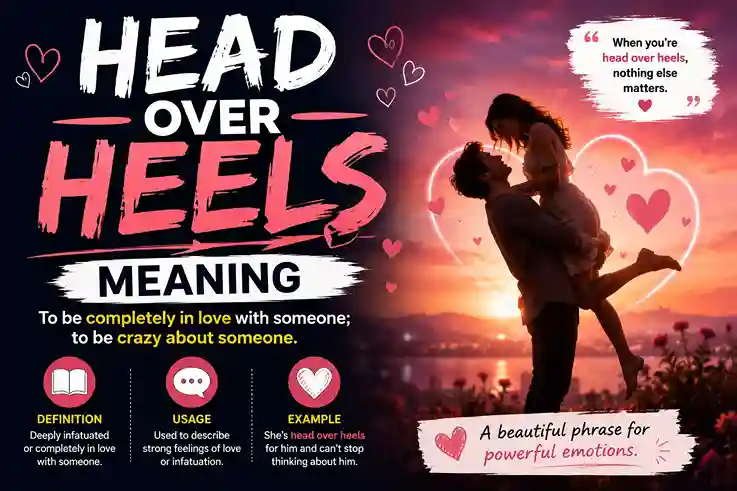
You’ve used “head over heels” to describe that dizzying feeling of falling in love. Yet the original head over heels meaning had nothing to do with romance—it painted a picture of a physical tumble. Using an idiom without knowing its roots can make you sound careless. This definitive guide clarifies the true definition, traces its surprising evolution, and shows you exactly how to use the phrase with confidence and emotional punch.
What Is the Exact Head Over Heels Meaning Today?
Today the head over heels meaning points to a state of complete, almost disorienting infatuation. When you say you are head over heels, you express that your emotions have completely overturned your normal composure. The feeling is so powerful that it leaves you unsteady, excited, and fully consumed by another person.
Modern dictionaries define the idiom as “completely in love.” Merriam-Webster notes the phrase describes a person who is deeply enamored, often to the point of losing rational control. The language suggests a pleasurable loss of balance—much like the physical sensation of tumbling.
The Surprising Origin: Why “Head Over Heels” Once Meant a Somersault
The earliest written records flip the modern head over heels meaning on its head. The phrase began as a literal description of turning the body upside down, like a cartwheel or somersault. In the 14th century, people said “heels over head”—a more accurate image because your heels actually go above your head when you tumble.
According to the Online Etymology Dictionary, the expression “heels over head” appeared in Middle English texts to describe a clumsy fall or a chaotic roll. By the 18th century, the wording gradually inverted to “head over heels,” even though the image became physically backward. Somehow, “head over heels” sounded better to the ear and stuck.
How the Head Over Heels Meaning Flipped into Romance
The shift from tumbling to love happened through figurative use. People started applying the image of a physical tumble to emotional experiences that knocked them off balance. First, the idiom described general confusion or disorder. By the late 1700s, writers linked the head over heels meaning to being so emotionally overthrown that you lost your footing in life.
The Oxford English Dictionary records a pivotal moment in 1771 when “head over heels” appeared in a romantic context. The transition made sense: falling in love often feels like losing control, exactly like a sudden somersault. That emotional disorientation gave the idiom its permanent romantic home.
Head Over Heels Meaning in Modern Relationships
In today’s relationships, the head over heels meaning signals an all-in, no-holds-barred emotional commitment. You don’t simply like someone; you feel utterly swept away. The phrase captures the early stages of a romance when everything about the other person seems perfect and time spent apart feels empty.
Psychologists call this the limerence phase—a period of intense longing and euphoric connection. While the idiom sounds lighthearted, this state can be so consuming that it affects sleep, appetite, and focus. Still, saying “I’m head over heels for you” remains one of the most heartfelt confessions in the English language.
Head Over Heels vs. Head Over Heels in Love: Is There a Difference?
People often ask if adding “in love” changes the head over heels meaning. In practice, the two phrases work interchangeably. “Head over heels” can stand alone as a shorthand for “head over heels in love.” No hidden nuance separates them.
However, you might encounter “head over heels” used outside of romance. Someone can be head over heels about a new job, a hobby, or a creative project. When love is the context, the full phrase “head over heels in love” adds clarity, but leaving out “in love” rarely confuses a listener because romance remains the dominant association.
Real-Life Examples: Using “Head Over Heels” in Everyday English
The head over heels meaning comes alive in everyday speech. Here are a few authentic examples:
- “After their first date, she was completely head over heels.”
- “He fell head over heels the moment he saw her smile.”
- “They’re still head over heels after twenty years of marriage.”
You can use the phrase in text messages, personal essays, or conversations with friends. It fits naturally into stories about relationships, weddings, and even surprise crushes.
Synonyms That Capture the Head Over Heels Meaning (with Nuance)
While no single word matches the full idiomatic flavor, several synonyms come close. Each carries a slightly different intensity or context. Use this table to choose the right expression.
| Synonym | Meaning | Intensity (1-10) | Example Sentence |
|---|---|---|---|
| Madly in love | Extremely passionate about someone | 9 | “He’s madly in love with his partner.” |
| Smitten | Suddenly and strongly attracted | 8 | “She was smitten after one conversation.” |
| Infatuated | Obsessively captivated, often short-lived | 7 | “He’s infatuated with her beauty.” |
| Besotted | Completely intoxicated by love | 8 | “They are utterly besotted with each other.” |
| Enamored | Charmed and captivated | 7 | “She became enamored with his kindness.” |
| Crazy about | Very enthusiastic and affectionate | 8 | “He’s crazy about her sense of humor.” |
The head over heels meaning sits at the top of the intensity scale, matched only by “madly in love.” It implies a joyful, all-consuming devotion.
Common Mistakes When Using “Head Over Heels” (and How to Avoid Them)
- Misplacing the phrase in formal writing. “Head over heels” belongs in conversational and creative contexts. Avoid it in academic papers or business reports.
- Adding unnecessary words. Say “I’m head over heels,” not “I’m head over heels for her in love.” That’s redundant.
- Confusing it with “head over heels in debt.” The idiom never refers to financial trouble. Keep it strictly for intense emotion.
- Using it for mild liking. The head over heels meaning demands overwhelming feeling. You can’t be “slightly head over heels.”
The Psychology Behind Falling Head Over Heels
Brain chemistry explains why the head over heels meaning feels so physical. During the early stages of romantic love, dopamine and norepinephrine flood your system. These chemicals create euphoria, racing thoughts, and a laser focus on your partner. Your body literally experiences a loss of equilibrium, mimicking the sensation of a tumble.
Anthropologist Helen Fisher describes this as the “attraction system,” a biological drive that evolved to focus mating energy on one person. Understanding this science doesn’t dim the romance—it deepens your appreciation for why the metaphor works so well.
Cultural References: Head Over Heels in Music, Film, and Literature
Pop culture adopted the head over heels meaning early and often. Tears for Fears released the iconic song “Head Over Heels” in 1985, capturing the dizzying vulnerability of love. In film, countless romantic comedies use the phrase in titles or pivotal dialogue to signal a character’s total emotional surrender.
Literature relies on the idiom too. Jane Austen’s characters may not say “head over heels,” but they experience precisely that disorder. Modern novels frequently drop the phrase to show a character falling fast and completely.
How to Teach the Head Over Heels Meaning to English Learners
Idioms frustrate learners because literal translations fail. Explain the head over heels meaning by first showing the physical image of a somersault. Act it out or draw a stick figure tumbling. Then connect that to the feeling of losing emotional control.
- Start with the original “heels over head.”
- Contrast it with the modern romantic meaning.
- Offer fill-in-the-blank sentences: “After the first kiss, he was _____.”
- Play a clip of the Tears for Fears song to reinforce the phrase.
Visual, auditory, and kinesthetic cues make the idiom stick.
Head Over Heels Meaning in Texting and Social Media
On social platforms, the head over heels meaning often appears in captions, memes, and emoji-heavy posts. Couples share photos with “Still head over heels” to mark anniversaries. Friends comment “He’s head over heels” under a giddy video.
The hashtag #headoverheels has millions of posts on Instagram, mostly featuring weddings, engagements, and romantic travel. The tone stays playful and celebratory. Because the idiom feels warm and informal, it thrives in the casual language of the internet.
Frequently Asked Questions About the Head Over Heels Meaning
What does head over heels mean in love?
It means being completely, unreservedly in love—so much that you feel dizzy or overwhelmed by emotion.
Is head over heels a positive or negative phrase?
Positive. It describes enthusiastic, joyful romantic attraction, never harm or distress.
Why did head over heels change meaning?
The shift happened as speakers applied the literal tumble to emotional upset, then gradually narrowed it to the delightful disorder of love.
Can you use head over heels for things other than love?
Yes. You can be head over heels about a passion project, a new puppy, or an exciting opportunity, though romantic love remains the most common association.
What’s the difference between falling in love and head over heels?
Falling in love describes the gradual process. Head over heels captures the moment you are already fully, giddily immersed in that love.
Is head over heels informal?
Yes. Reserve it for conversations, personal writing, and social posts rather than formal or academic communication.
Now You Know—Use the Head Over Heels Meaning with Confidence
The head over heels meaning you carry away today isn’t just a dictionary entry. You’ve walked its strange journey from a clumsy somersault to the highest expression of romantic surrender. Every time you say “I’m head over heels,” you echo centuries of English speakers who knew that love turns you upside down in the best way. Share this guide with someone who makes you feel that wonderful tumble—or bookmark it for the next time words fail you.